
Scleral Lenses: The Game-Changer for Irregular Corneas and Severe Dry Eye
Scleral lenses vault over the cornea and rest on the sclera, creating a fluid reservoir that provides both optical correction and continuous corneal hydration. Here is who benefits most and what to expect.

Scleral Lenses: The Game-Changer for Irregular Corneas and Severe Dry Eye
For patients with irregular corneas, keratoconus, or severe dry eye, standard contact lenses — whether soft or conventional rigid gas-permeable — often cannot provide adequate vision correction or comfort. Scleral lenses represent a fundamentally different approach to contact lens design, and for the right patient, they are genuinely life-changing.
What Are Scleral Lenses?
Scleral lenses are large-diameter rigid gas-permeable (RGP) lenses that vault completely over the cornea and rest on the sclera (the white of the eye) rather than on the cornea itself. The space between the back surface of the lens and the front surface of the cornea is filled with preservative-free saline solution, creating a fluid reservoir that:
- Corrects irregular corneal surfaces — The fluid fills in the irregularities of the cornea, creating a smooth, regular optical surface
- Continuously hydrates the cornea — The saline reservoir bathes the corneal surface throughout the wearing period
- Eliminates lens-cornea contact — Because the lens rests on the sclera, not the cornea, there is no mechanical irritation of the corneal surface
Who Benefits From Scleral Lenses?
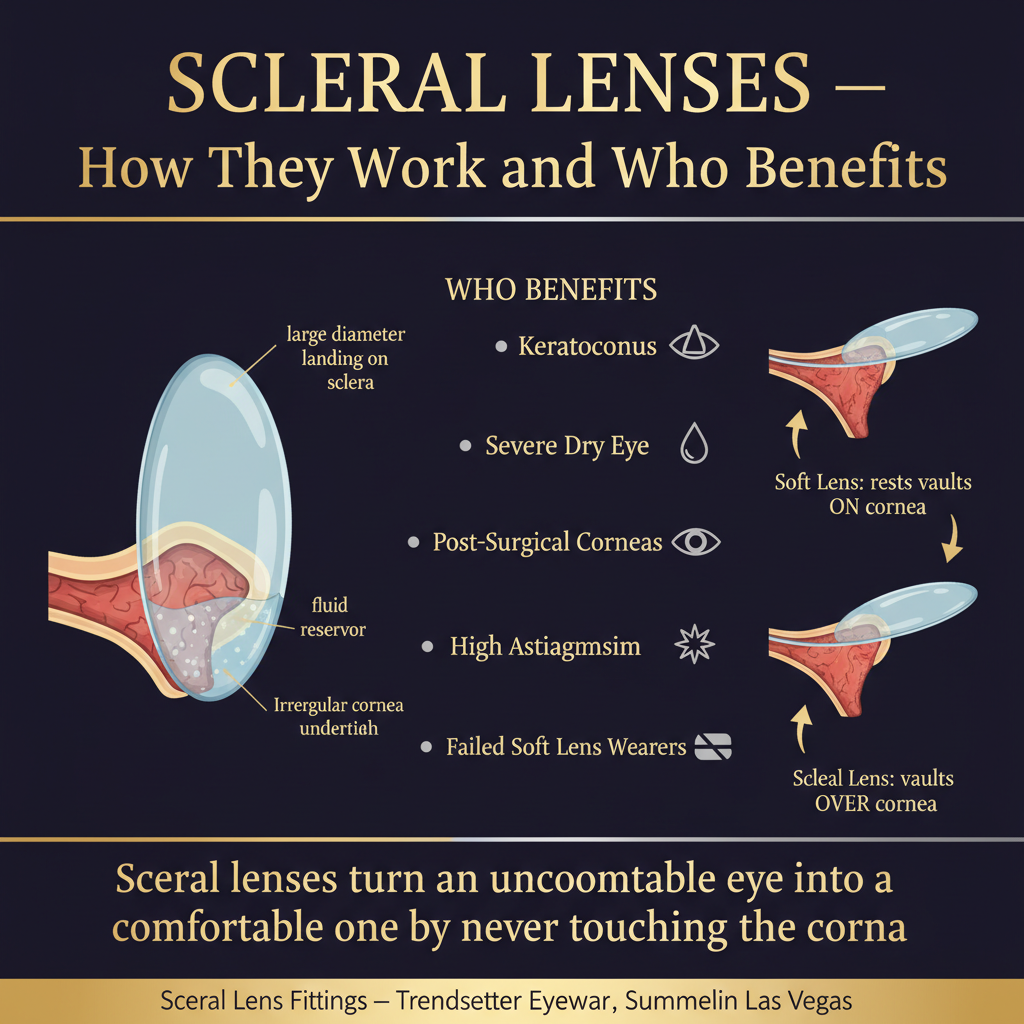
Scleral lenses succeed where soft lenses fail because they never touch the cornea — the saline reservoir bathes the ocular surface continuously, making them the gold standard for both irregular corneas and severe dry eye.
Keratoconus
Keratoconus is a progressive condition in which the cornea thins and bulges forward into a cone shape, causing irregular astigmatism that cannot be corrected with glasses or soft contact lenses. Scleral lenses are the gold standard for vision correction in keratoconus — the fluid vault neutralizes the irregular corneal surface and provides the sharp, stable vision that other options cannot achieve.
Post-Surgical Irregular Corneas
Patients who have had LASIK, PRK, or other corneal surgeries sometimes develop irregular corneal surfaces that cause ghosting, halos, and reduced visual quality. Scleral lenses can restore excellent vision in these cases.
Corneal Transplant
After penetrating keratoplasty (corneal transplant), the transplanted cornea often has significant irregular astigmatism. Scleral lenses provide excellent vision correction while the transplant heals and stabilizes.
Severe Dry Eye
For patients with severe dry eye — including those with Sjögren's syndrome, graft-versus-host disease, Stevens-Johnson syndrome, or severe meibomian gland dysfunction — scleral lenses provide continuous corneal hydration throughout the wearing period. Many patients who cannot tolerate any other contact lens wear scleral lenses comfortably for 12–16 hours per day.
Corneal Dystrophies and Degenerations
Various corneal conditions — including pellucid marginal degeneration, Fuchs' dystrophy, and corneal scarring — can be managed with scleral lenses when other options are inadequate.
The Fitting Process
Scleral lens fitting is a specialized process that requires expertise and multiple appointments. At Trendsetter Eyewear, the fitting process includes:
- Corneal topography — Detailed mapping of the corneal surface to guide lens design
- Scleral topography (when indicated) — Mapping of the scleral surface for optimal landing zone design
- Trial lens fitting — Multiple trial lenses are evaluated to find the optimal vault height, landing zone, and optical power
- Over-refraction — Fine-tuning the optical power with the trial lens in place
- Training — Instruction in insertion, removal, and care of scleral lenses (the technique is different from standard contact lenses)
- Follow-up visits — To assess fit, comfort, and vision over time
The fitting process typically requires 2–4 appointments before the final lenses are ordered.
Wearing Scleral Lenses
Insertion
Scleral lenses are inserted differently from standard contact lenses. The lens is filled with preservative-free saline, then placed on the eye using a plunger or three-finger technique. The saline must fill the bowl of the lens completely — any air bubbles will cause discomfort and visual disturbance.
Wearing Time
Most patients can wear scleral lenses for 12–16 hours per day. The saline reservoir may need to be refreshed mid-day in some patients, particularly those with severe dry eye.
Care
Scleral lenses require daily cleaning and disinfection with appropriate RGP lens solutions. They should not be used with standard soft lens solutions.
Scleral Lenses in Las Vegas
The dry, low-humidity environment of Las Vegas makes scleral lenses particularly valuable for patients with dry eye — the fluid reservoir provides a level of corneal hydration that no other contact lens can match in this climate.
Call (702) 479-5222 or schedule a scleral lens consultation at Trendsetter Eyewear in Summerlin, Las Vegas. Dr. Cynthia Payne has extensive experience fitting scleral lenses for patients with complex corneal and ocular surface conditions.
Explore Topics
Written by
Dr. Cynthia Payne, OD
Content creator and writer sharing insights and stories.


