
BVD: The Vision Problem Hiding Behind Your Headaches and Anxiety
Binocular Vision Dysfunction is routinely misdiagnosed as migraines, anxiety, ADHD, or concussion. Here is how to recognize it — and what actually helps.

BVD: The Vision Problem Hiding Behind Your Headaches and Anxiety
You've seen your primary care doctor. You've been to a neurologist. Maybe you've tried migraine medication, anxiety treatment, or physical therapy for neck pain. Nothing has fully worked — and no one has been able to explain why you feel the way you do.
There's a possibility that hasn't been explored: your eyes may not be working together properly.
Binocular Vision Dysfunction (BVD) is a condition where the two eyes are slightly misaligned, forcing the brain to constantly work to fuse the images they produce. This constant neurological effort creates a cascade of symptoms that look exactly like other conditions — which is why BVD is one of the most frequently misdiagnosed problems in medicine.
What Is Binocular Vision Dysfunction?
Your two eyes need to point at exactly the same spot at the same time for your brain to create a single, clear image. When there's even a tiny misalignment — sometimes just fractions of a millimeter — your brain has to work overtime to compensate and prevent double vision.
This compensation is largely unconscious. You don't see double. You don't even know it's happening. But the effort required to maintain that compensation, hour after hour, day after day, creates real neurological strain that manifests as physical symptoms throughout the body.
BVD is not the same as a lazy eye (amblyopia) or a crossed eye (strabismus). Those are visible misalignments. BVD involves subtle misalignments that standard eye exams typically miss entirely.
Symptoms That Are Actually BVD
The symptom list for BVD is long and varied — which is part of why it's so often attributed to other causes:
Head and Neck
- Chronic headaches, especially behind the eyes or at the temples
- Neck pain and stiffness
- Shoulder tension
- Dizziness and vertigo
- Feeling off-balance or unsteady
Vision
- Blurry or fluctuating vision (even with a current glasses prescription)
- Difficulty reading — words seem to move, blur, or run together
- Losing your place while reading
- Eye strain and fatigue after short periods of reading or screen use
- Light sensitivity
- Difficulty with depth perception
Neurological and Psychological
- Anxiety, especially in open spaces, crowds, or busy visual environments
- Difficulty concentrating or focusing
- Brain fog
- Motion sickness
- Sensitivity to busy patterns, fluorescent lights, or moving objects
Post-Concussion
BVD is extremely common after traumatic brain injury or concussion. Many patients with persistent post-concussion syndrome have an underlying BVD that was never identified.
Why BVD Gets Misdiagnosed
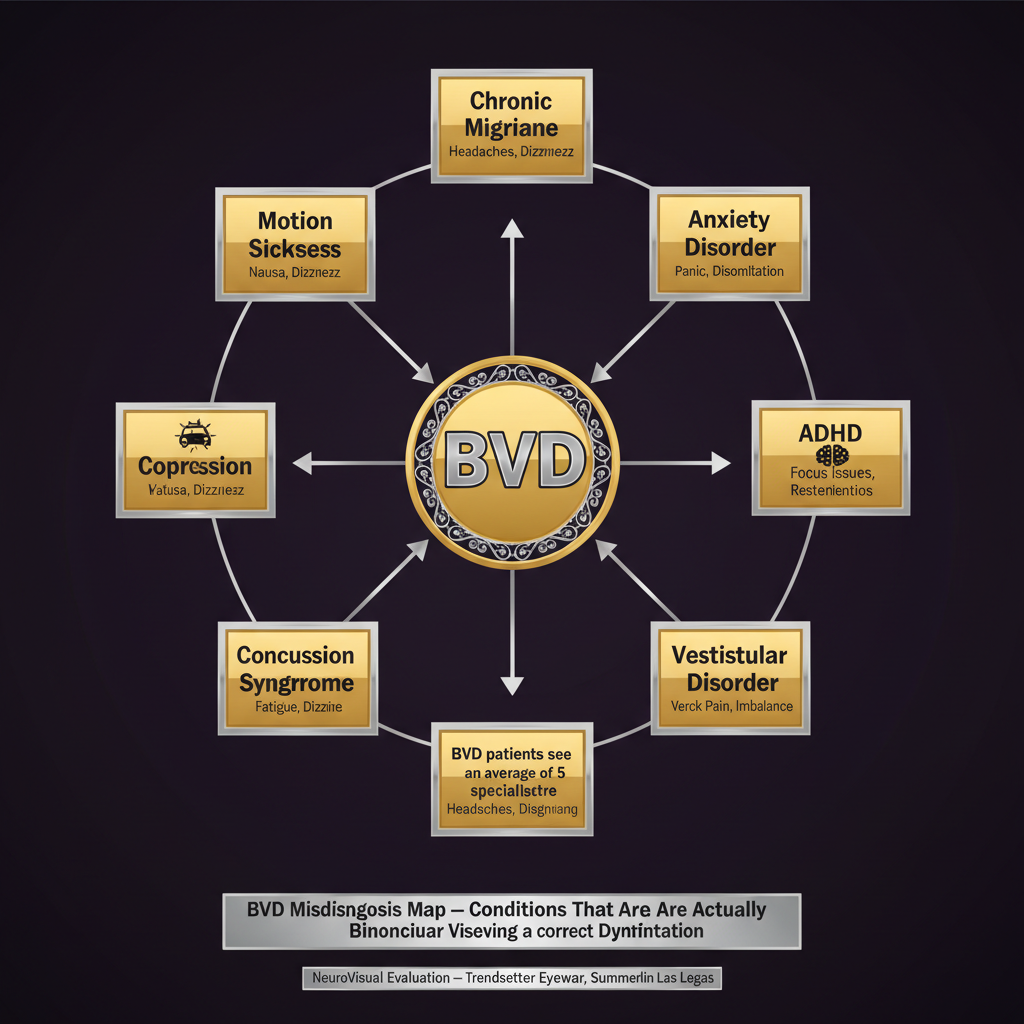
Each misdiagnosis makes sense in isolation — the symptoms genuinely overlap. What's missing is a test that measures the eyes working together, not just each eye independently.
The conditions BVD is most commonly mistaken for include:
Migraines: The headache pattern, light sensitivity, and visual disturbances of BVD closely mimic migraines. Many BVD patients have been on migraine medication for years with incomplete relief.
Anxiety disorder: The dizziness, unsteadiness, and discomfort in busy environments that BVD causes can look exactly like anxiety. Some patients are prescribed anti-anxiety medication when the root cause is visual.
ADHD: Difficulty reading, losing place on the page, poor concentration, and avoidance of reading tasks are classic BVD symptoms — and classic ADHD symptoms. Children with BVD are frequently misdiagnosed with ADHD.
Vestibular disorders: Dizziness and balance problems from BVD are often attributed to inner ear issues. Vestibular therapy may help somewhat, but it doesn't address the visual root cause.
Cervicogenic headache: Neck pain and headaches from BVD are often attributed to cervical spine problems. Chiropractic care and physical therapy may provide temporary relief but don't resolve the underlying visual misalignment.
Post-concussion syndrome: After a head injury, BVD can develop or worsen. Many patients with lingering post-concussion symptoms have undiagnosed BVD.
Why Standard Eye Exams Miss BVD
A standard eye exam checks visual acuity (how clearly you see the letters on the chart) and screens for common conditions like glaucoma and macular degeneration. It is not designed to detect the subtle binocular vision misalignments that cause BVD.
Detecting BVD requires specialized testing that measures how well your eyes work together — not just how well each eye sees individually. This includes testing for vertical and horizontal phoria (the tendency of the eyes to drift), vergence (the ability to converge and diverge), and the brain's ability to fuse images from both eyes.
At Trendsetter Eyewear, Dr. Payne uses a comprehensive NeuroVisual evaluation protocol specifically designed to identify these subtle misalignments.
How BVD Is Treated: Micro-Prism Lenses
The primary treatment for BVD is micro-prism lenses — specialized prescription lenses that contain tiny prism corrections that redirect light entering the eye, effectively compensating for the misalignment and reducing the neurological effort required to maintain single vision.
These are not the large prisms used for strabismus. Micro-prisms are subtle corrections, often just fractions of a prism diopter, that are incorporated into regular-looking glasses.
The results can be dramatic. Many patients report significant reduction in headaches, dizziness, and anxiety within days of wearing their new lenses. Reading becomes easier. Concentration improves. The constant background effort of compensating for misaligned eyes simply stops.
NeuroLens
Dr. Payne is a trained NeuroLens provider. NeuroLens uses a proprietary measurement device to precisely quantify the degree of eye misalignment and calculate the exact prism correction needed. Clinical studies show that 93% of NeuroLens patients report significant relief from their symptoms.
Take the BVD Questionnaire
Not sure if BVD could be behind your symptoms? We offer a free BVD questionnaire that takes about 2 minutes to complete. It's not a diagnosis, but it can help you understand whether a NeuroVisual evaluation makes sense for you.
Who Should Consider a NeuroVisual Evaluation?
You may benefit from a NeuroVisual evaluation if you:
- Have chronic headaches that haven't responded fully to treatment
- Experience dizziness, vertigo, or balance problems
- Struggle with reading, concentration, or screen use
- Have anxiety that seems to worsen in visually busy environments
- Are recovering from a concussion or traumatic brain injury
- Have been told you have post-concussion syndrome
- Experience neck pain or shoulder tension alongside visual symptoms
Schedule a NeuroVisual Evaluation in Las Vegas
Dr. Payne has dedicated a significant portion of her practice to NeuroVisual Medicine because she has seen firsthand how transformative the right diagnosis can be for patients who have been suffering for years.
If any of this resonates with your experience, we'd encourage you to reach out. A NeuroVisual evaluation is a thorough, non-invasive process — and for many patients, it's the first time anyone has looked at their vision as a potential source of their symptoms.
You deserve answers. Let's find them.
Frequently Asked Questions
What is Binocular Vision Dysfunction and what causes it?
Binocular Vision Dysfunction (BVD) is a condition where the two eyes are subtly misaligned, forcing the brain to constantly compensate to prevent double vision. This neurological effort produces a wide range of symptoms — headaches, dizziness, anxiety, reading difficulty, and neck pain — that are frequently attributed to other conditions.
How is BVD different from a lazy eye or a crossed eye?
A lazy eye (amblyopia) and crossed eye (strabismus) involve visible misalignments. BVD involves subtle misalignments — sometimes just fractions of a millimeter — that are not visible to the naked eye and are not detected by standard eye exams. The misalignment is real and measurable, but it requires specialized testing to find.
Why does Binocular Vision Dysfunction cause anxiety and dizziness?
The dizziness, unsteadiness, and visual discomfort that BVD produces in busy environments — crowds, stores, moving traffic — can trigger or amplify anxiety responses. The brain is working overtime to process conflicting visual signals, which creates a state of neurological stress that feels like anxiety. Many BVD patients have been prescribed anti-anxiety medication when the root cause was visual.
Why does a standard eye exam miss Binocular Vision Dysfunction?
No. A standard eye exam checks visual acuity and screens for common conditions. It does not measure how well the two eyes work together. Detecting BVD requires specialized testing for vertical and horizontal phoria, vergence, and binocular fusion — the kind of comprehensive NeuroVisual evaluation Dr. Payne performs at Trendsetter Eyewear.
How is Binocular Vision Dysfunction treated?
The primary treatment is micro-prism lenses — prescription lenses containing tiny prism corrections that redirect light to compensate for the misalignment. These are incorporated into regular-looking glasses. Results can be dramatic: many patients report significant reduction in headaches, dizziness, and anxiety within days of wearing their new lenses.
Is Binocular Vision Dysfunction common after a concussion?
Yes. BVD is extremely common after traumatic brain injury or concussion. A head injury can disrupt the precise coordination between the eyes, creating or worsening a binocular vision misalignment. Many patients with persistent post-concussion syndrome have an undiagnosed BVD that is driving their ongoing symptoms.
Explore Topics
Written by
Dr. Cynthia Payne, OD
Content creator and writer sharing insights and stories.


