
Dry Eye and Menopause: Why Hormonal Changes Affect Your Tear Film
Many women first develop chronic dry eye during perimenopause or menopause. The connection between estrogen, androgen, and tear film health is well-established — and treatable. Here is what you need to know.

Dry Eye and Menopause: Why Hormonal Changes Affect Your Tear Film
If you are a woman in your 40s or 50s and your eyes have suddenly become dry, irritated, or uncomfortable — you are not imagining it. Hormonal changes associated with perimenopause and menopause are one of the most significant and underrecognized triggers of dry eye disease. Understanding this connection is the first step toward finding lasting relief.
The Hormone-Tear Film Connection
Your tear film is not just water. It is a complex three-layer structure — an oily outer layer, an aqueous middle layer, and a mucin inner layer — each produced by different glands in and around the eye. Hormones play a critical role in regulating all three layers.
Androgens and the Meibomian Glands
The meibomian glands — which produce the oily outer layer of your tears — are androgen-dependent. Androgens (including testosterone and DHEA) stimulate meibomian gland secretion and maintain the quality of the lipid layer. As androgen levels decline during menopause, meibomian gland function often deteriorates, leading to evaporative dry eye.
Research published in Investigative Ophthalmology & Visual Science has consistently shown that androgen deficiency is a primary driver of meibomian gland dysfunction in postmenopausal women.
Estrogen and the Lacrimal Glands
The lacrimal glands — which produce the aqueous (watery) component of tears — are also influenced by estrogen. The relationship is complex: some research suggests estrogen has a protective effect on lacrimal gland function, while other studies indicate that estrogen replacement therapy may actually worsen dry eye symptoms in some women.
This complexity is one reason why hormone replacement therapy (HRT) does not reliably resolve dry eye — and why targeted ocular treatments are often necessary.
The Inflammatory Component
Menopause is also associated with increased systemic inflammation, which can affect the ocular surface directly. Inflammatory cytokines disrupt the tear film, damage goblet cells (which produce the mucin layer), and accelerate meibomian gland dysfunction.
Symptoms of Hormonal Dry Eye
Dry eye associated with menopause often presents with:
- Burning, stinging, or gritty sensation — often worse in the afternoon or evening
- Excessive tearing (paradoxical — the eye produces reflex tears in response to dryness)
- Blurred vision that fluctuates, especially during reading or screen use
- Sensitivity to wind, air conditioning, and low-humidity environments (Las Vegas is particularly challenging)
- Contact lens discomfort that develops after years of comfortable wear
- Eye fatigue and difficulty with prolonged visual tasks
Why Las Vegas Makes It Worse
The desert climate of Las Vegas — with its extremely low humidity, intense sun, and pervasive air conditioning — creates an environment that accelerates tear evaporation. For women already experiencing hormonal dry eye, Las Vegas living can push symptoms from manageable to debilitating. This is why we see a disproportionately high number of perimenopausal and postmenopausal women seeking dry eye treatment at our Summerlin practice.
Treatment Options for Hormonal Dry Eye
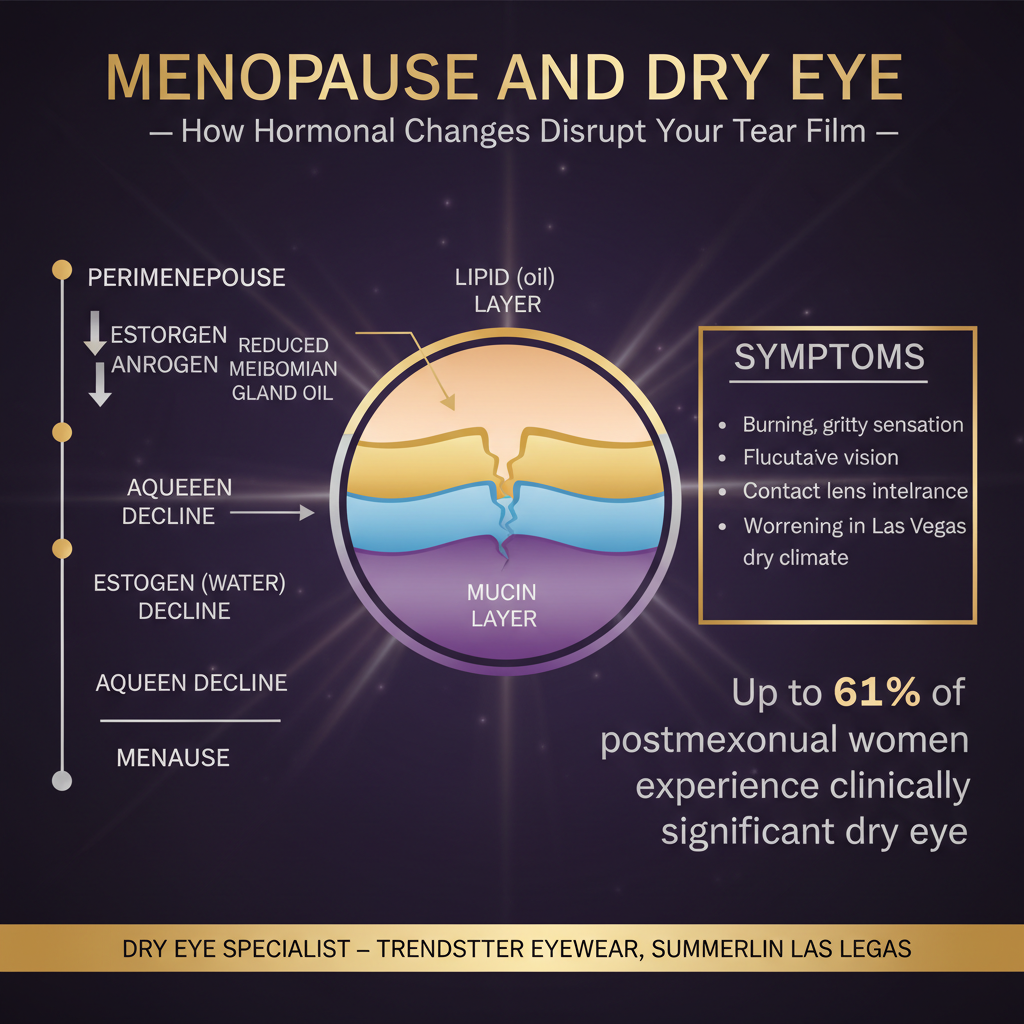
Hormonal dry eye is not just "getting older" — it is a predictable physiological change with effective, targeted treatments. Understanding the mechanism is the first step to lasting relief.
The good news: hormonal dry eye responds well to the same advanced treatments we use for other forms of dry eye — and in many cases, the results are dramatic.
IPL Therapy
Intense Pulsed Light therapy reduces the periocular inflammation that drives meibomian gland dysfunction. For women with ocular rosacea (which often worsens during menopause), IPL is particularly effective.
OptiPlus RF
Radiofrequency therapy directly restores meibomian gland function by delivering controlled heat energy to the eyelid tissue. It is one of the most effective treatments for the gland atrophy that accompanies androgen decline.
Prescription Drops
Cyclosporine (Restasis, Cequa) and lifitegrast (Xiidra) address the inflammatory component of dry eye at the ocular surface level. These are often used alongside in-office treatments for comprehensive management.
Punctal Plugs
Small silicone plugs inserted into the tear drainage ducts can help retain natural tears on the ocular surface — a useful option for patients with aqueous-deficient dry eye.
Lifestyle Modifications
- Humidifiers at home and in the office
- Omega-3 supplementation (see our guide to omega-3s and dry eye)
- Staying well-hydrated
- Wearing wraparound sunglasses outdoors in Las Vegas
When to See a Specialist
If you are experiencing dry eye symptoms that are affecting your quality of life — particularly if they developed or worsened during perimenopause or menopause — it is worth seeing a dry eye specialist rather than relying on over-the-counter drops alone.
At Trendsetter Eyewear, Dr. Cynthia Payne performs a comprehensive dry eye evaluation that includes meibography (imaging of your meibomian glands), tear film analysis, and osmolarity testing to identify the specific type and severity of your dry eye. This allows us to design a treatment plan that addresses your actual condition — not just your symptoms.
Call (702) 479-5222 or schedule your dry eye evaluation at our Summerlin, Las Vegas location. Relief is possible — and you deserve to feel comfortable in your own eyes again.
Related reading:
- Dry Eye Spa treatments in Las Vegas — IPL, OptiPlus RF, NuLids & meibomian gland expression
- IPL therapy for dry eye — particularly effective for rosacea-related dry eye
- Omega-3 fatty acids and dry eye — how nutrition supports tear film health
Frequently Asked Questions
Why does dry eye get worse during menopause — what's the connection?
Estrogen and androgen receptors are present throughout the ocular surface and meibomian glands. As estrogen and testosterone levels decline during perimenopause and menopause, meibomian gland function decreases, producing less oil for the tear film. This leads to increased tear evaporation and the characteristic burning, stinging, and fluctuating vision of evaporative dry eye.
Does hormone replacement therapy actually help with dry eye during menopause?
The relationship between HRT and dry eye is complex. Some studies suggest estrogen-only HRT may worsen dry eye, while combined estrogen-progesterone therapy may have a neutral or slightly beneficial effect. Androgen supplementation shows more consistent benefit for meibomian gland function. The decision about HRT involves many factors beyond eye health — discuss it with your gynecologist or endocrinologist.
What dry eye treatments work best for women going through menopause?
Treatments that address meibomian gland dysfunction are most effective for menopausal dry eye. IPL therapy reduces the inflammatory load on the meibomian glands and is particularly effective for patients with rosacea-related MGD, which is common in perimenopausal women. OptiPlus RF directly heats and remodels gland tissue. Omega-3 supplementation supports gland function. Prescription drops like Restasis or Xiidra address the inflammatory component.
Is dry eye during menopause permanent, or will it improve over time?
Menopausal dry eye is typically a chronic condition that requires ongoing management rather than a temporary phase. However, with appropriate treatment, most patients achieve significant symptom relief and maintain comfortable vision. The goal is to find the right combination of in-office treatments and at-home maintenance to keep symptoms well-controlled.
Can perimenopause cause dry eye symptoms before menopause is complete?
Yes. Hormonal fluctuations during perimenopause — which can begin years before the final menstrual period — can trigger or worsen dry eye. Many women first notice significant dry eye symptoms in their 40s during perimenopause, well before menopause is complete. If you are experiencing new or worsening dry eye symptoms and are in your 40s or 50s, a dry eye evaluation is worthwhile regardless of where you are in the menopausal transition.
To find out which dry eye treatment is right for you, schedule a dry eye evaluation at Trendsetter Eyewear in Summerlin, Las Vegas — call (702) 479-5222.
Explore Topics
Written by
Dr. Cynthia Payne, OD
Content creator and writer sharing insights and stories.


