
Why Your Eyes Feel Worse in the Morning: Nighttime Dry Eye Explained
Waking up with painful, crusty, or blurry eyes is not normal. Nighttime dry eye and nocturnal lagophthalmos are common but underdiagnosed conditions. Here is what causes them and how to treat them.

Why Your Eyes Feel Worse in the Morning: Nighttime Dry Eye Explained
For many dry eye patients, the worst part of the day is not staring at a screen for hours or spending time in air conditioning — it is waking up. If your eyes feel gritty, painful, stuck together, or blurry first thing in the morning, you are experiencing a phenomenon that has specific causes and specific solutions.
What Causes Morning Dry Eye?
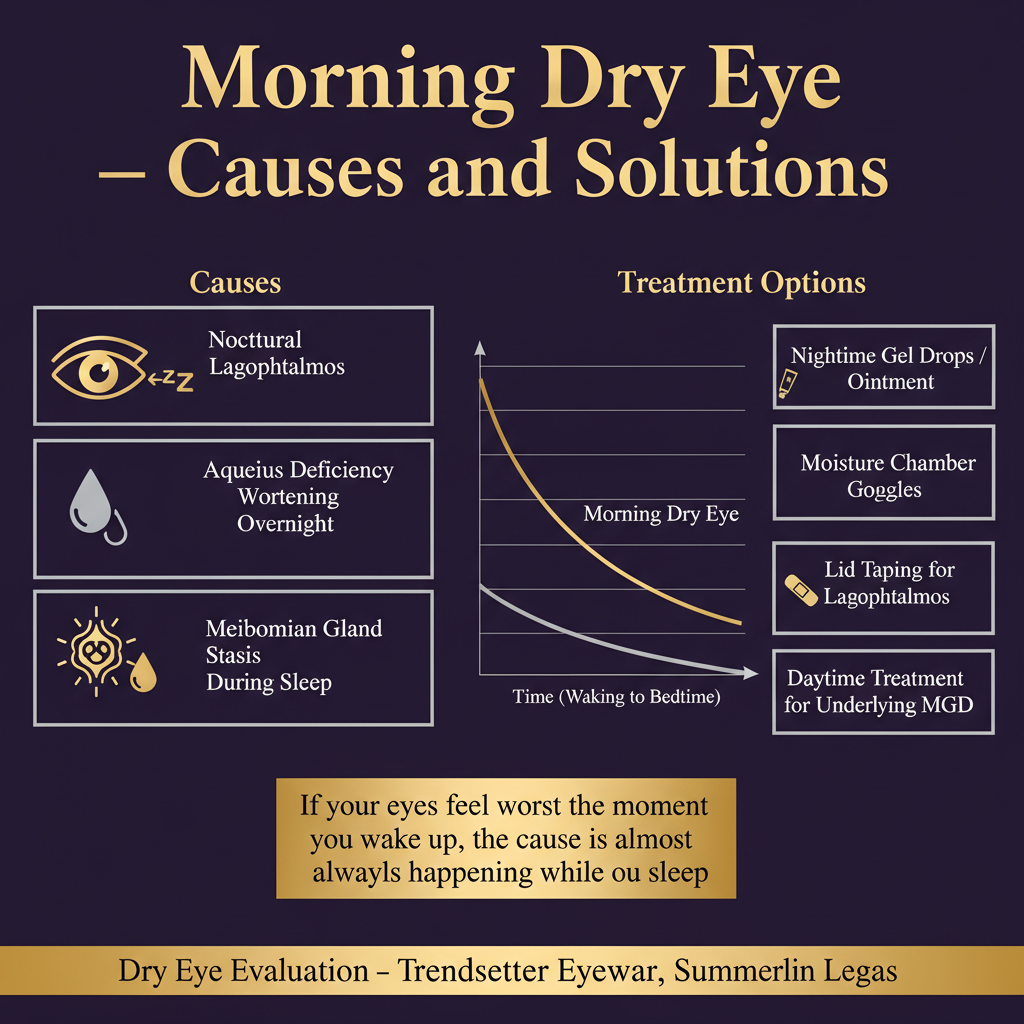
The symptom timeline is the key diagnostic clue: if your eyes feel worst the moment you wake up and improve as the day goes on, the cause is almost certainly happening while you sleep.
1. Nocturnal Lagophthalmos
Nocturnal lagophthalmos is the medical term for sleeping with your eyes partially open. It is far more common than most people realize — studies suggest it affects up to 20% of the population, and many people have no idea it is happening.
When the eyelids do not fully close during sleep, the cornea is exposed to air for hours. Without the protective blink reflex and the constant renewal of the tear film, the exposed area dries out, becomes irritated, and can even develop small corneal erosions. Patients with nocturnal lagophthalmos often wake with:
- Intense burning or stinging that improves after blinking for a few minutes
- Redness concentrated in the lower or central cornea
- A feeling that something is in the eye
- Blurred vision that clears after blinking or using drops
Lagophthalmos can result from facial nerve weakness, prominent eyes (proptosis), eyelid scarring, or simply the way your anatomy relaxes during sleep.
2. Reduced Blink Rate and Tear Production During Sleep
Even in people whose eyes close fully, tear production slows significantly during sleep. The lacrimal glands produce fewer tears, and the meibomian glands secrete less oil. For patients who already have compromised tear film function, this overnight reduction can push the ocular surface into a symptomatic state by morning.
3. Meibomian Gland Congestion
During sleep, meibum (the oil secreted by meibomian glands) can thicken and accumulate at the gland openings. In patients with meibomian gland dysfunction, this congestion is more pronounced, leading to a thick, foamy discharge at the lid margins and a disrupted tear film upon waking.
4. CPAP Use
Patients who use CPAP machines for sleep apnea frequently experience morning dry eye. Air leaking from the mask — particularly around the nose bridge — can blow across the eyes during sleep, dramatically accelerating tear evaporation. This is a recognized and common complication of CPAP therapy.
How to Diagnose the Cause
Identifying the specific cause of your morning dry eye requires a clinical evaluation. At Trendsetter Eyewear, Dr. Payne will:
- Examine your eyelid closure during a simulated sleep position
- Assess your meibomian gland health with meibography
- Evaluate your corneal surface for signs of exposure damage
- Review your sleep habits, CPAP use, and medication history
Treatment Options
For Nocturnal Lagophthalmos
- Moisture chamber goggles or sleep masks create a humid microenvironment around the eyes during sleep
- Nighttime lubricating gels or ointments (thicker than drops) provide extended protection
- Eyelid taping can help keep lids fully closed in mild cases
- Scleral lenses worn during waking hours can help heal the corneal surface
For Meibomian Gland Dysfunction
- IPL therapy and OptiPlus RF address the root cause of gland dysfunction
- Warm compresses in the morning help liquefy and express accumulated meibum
- Lid hygiene with hypochlorous acid sprays reduces bacterial load at the lid margins
For CPAP-Related Dry Eye
- Adjusting mask fit to minimize air leakage
- Using a full-face mask instead of nasal mask
- Adding a heated humidifier to the CPAP circuit
- Nighttime lubricating drops or gel before sleep
When Morning Symptoms Signal Something More Serious
Occasionally, severe morning eye pain — particularly if accompanied by light sensitivity, significant vision loss, or a visible white spot on the cornea — can indicate a corneal erosion or ulcer. These require prompt evaluation. Do not wait for a scheduled appointment if you experience sudden, severe eye pain upon waking.
Get to the Root of Your Morning Dry Eye
If you are starting every day with uncomfortable eyes, there is no reason to accept that as normal. A thorough dry eye evaluation at Trendsetter Eyewear can identify exactly what is happening overnight and give you a clear path to waking up with comfortable eyes.
Call (702) 479-5222 or book your evaluation at our Summerlin, Las Vegas location.
Frequently Asked Questions
Why are my eyes so dry and painful when I wake up in the morning?
Morning dry eye is typically caused by one of three things: nocturnal lagophthalmos (sleeping with eyes partially open), reduced tear production during sleep, or meibomian gland congestion that accumulates overnight. The key diagnostic clue is the symptom timeline — if your eyes feel worst on waking and improve as the day goes on, the cause is almost certainly happening while you sleep.
What is nocturnal lagophthalmos — and could it be causing my morning eye pain?
Nocturnal lagophthalmos is the condition of sleeping with your eyes partially open. It affects up to 20% of the population and is often unrecognized. When the eyelids do not fully close, the cornea is exposed to air for hours, causing dryness, irritation, and sometimes small corneal erosions. Patients typically wake with intense burning that improves after blinking for a few minutes.
How is nocturnal lagophthalmos treated?
Treatment options include moisture chamber goggles or sleep masks (which create a humid microenvironment around the eyes), nighttime lubricating gels or ointments, and in some cases eyelid taping. The underlying cause — whether facial nerve weakness, prominent eyes, or anatomical factors — guides the specific approach.
Can using a CPAP machine cause or worsen dry eye?
Yes. Air leaking from a CPAP mask — particularly around the nose bridge — can blow across the eyes during sleep, dramatically accelerating tear evaporation. CPAP-related dry eye is a recognized and common complication. Solutions include adjusting mask fit, switching to a full-face mask, or adding a heated humidifier to the CPAP circuit.
When should I see an eye doctor about morning eye pain or dryness?
Severe morning eye pain — particularly if accompanied by light sensitivity, significant vision loss, or a visible white spot on the cornea — can indicate a corneal erosion or ulcer requiring prompt evaluation. Do not wait for a scheduled appointment if you experience sudden, severe eye pain upon waking. For persistent morning discomfort without these warning signs, a dry eye evaluation will identify the cause and guide treatment.
Explore Topics
Written by
Dr. Cynthia Payne, OD
Content creator and writer sharing insights and stories.


