
Glaucoma: The Silent Thief of Sight — What You Need to Know
Glaucoma affects over 3 million Americans and is the leading cause of irreversible blindness worldwide — yet most people have no symptoms until significant vision is already lost. Here is what glaucoma is, who is at risk, and how regular eye exams protect your sight.

Glaucoma: The Silent Thief of Sight — What You Need to Know
Glaucoma is called the "silent thief of sight" for a reason: it steals your vision gradually, painlessly, and without warning — until significant, irreversible damage has already occurred. It is the leading cause of preventable blindness worldwide, affecting over 3 million Americans. And yet, because it causes no symptoms in its early stages, roughly half of all people with glaucoma do not know they have it.
The good news: when detected early, glaucoma can almost always be managed effectively to preserve your vision for life. Regular comprehensive eye exams are your most powerful protection.
What Is Glaucoma?
Glaucoma is a group of eye diseases that damage the optic nerve — the cable that carries visual information from the retina to the brain. The most common form, primary open-angle glaucoma, is associated with elevated intraocular pressure (IOP) that gradually damages the optic nerve fibers over time.
However, it is important to understand that glaucoma can occur at normal eye pressure (normal-tension glaucoma), and elevated eye pressure does not always cause glaucoma. The relationship between pressure and optic nerve damage is complex and individual — which is why a comprehensive evaluation is essential.
How Glaucoma Damages Vision
The optic nerve contains approximately 1.2 million nerve fibers. Glaucoma damages these fibers progressively, starting with the peripheral (side) vision. Because the brain compensates remarkably well for peripheral vision loss, most patients do not notice any change in their vision until 30–40% of nerve fibers have already been destroyed.
By the time a patient notices visual symptoms — tunnel vision, difficulty driving at night, or bumping into objects — the disease is typically in an advanced stage. This is why waiting for symptoms is not a viable strategy.
Risk Factors for Glaucoma
Anyone can develop glaucoma, but certain factors significantly increase your risk:
- Age — Risk increases substantially after age 60; African Americans are at higher risk after age 40
- Family history — Having a first-degree relative with glaucoma increases your risk 4–9 times
- Elevated intraocular pressure — The most significant modifiable risk factor
- African, Hispanic, or Asian ancestry — These populations have higher rates of certain glaucoma types
- Thin corneas — Associated with higher risk of optic nerve damage at a given pressure
- Myopia (nearsightedness) — Particularly high myopia increases glaucoma risk
- Diabetes and hypertension — Associated with increased glaucoma risk
- Long-term corticosteroid use — Can elevate intraocular pressure
- Previous eye injury — Trauma can damage the drainage structures of the eye
How Glaucoma Is Detected
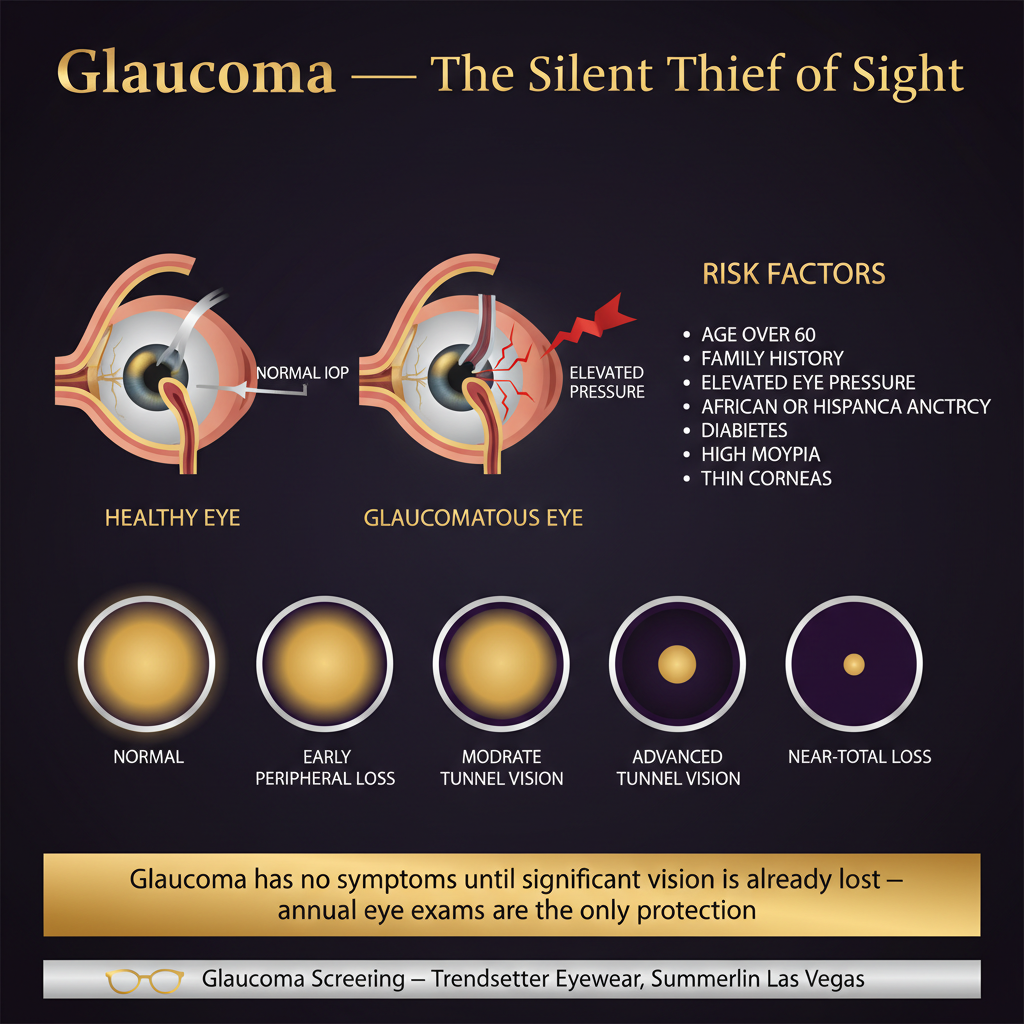
By the time glaucoma affects your central vision — the vision you use to read and recognize faces — up to 40% of nerve fibers may already be permanently lost. Detection only happens through examination, never through symptoms.
A comprehensive glaucoma evaluation at Trendsetter Eyewear includes:
- Intraocular pressure measurement using iCare tonometry (no air puff required)
- Optic nerve examination — Direct visualization of the optic nerve head
- OCT retinal nerve fiber layer analysis — Measures the thickness of the nerve fiber layer with micron-level precision, detecting thinning before it is visible on examination
- Visual field testing — Maps peripheral vision to detect functional loss
- Corneal thickness measurement (pachymetry) — Thin corneas are associated with higher glaucoma risk and affect the interpretation of pressure readings
- Gonioscopy (when indicated) — Examines the drainage angle of the eye
Treatment Options
Glaucoma treatment focuses on lowering intraocular pressure to slow or halt optic nerve damage. Options include:
- Prescription eye drops — The most common first-line treatment; various classes of drops reduce pressure by different mechanisms
- Laser therapy (SLT) — Selective Laser Trabeculoplasty improves drainage and can reduce or eliminate the need for drops
- Surgical procedures — For advanced cases or when drops and laser are insufficient
The goal of treatment is not to restore lost vision — glaucoma damage is permanent — but to preserve the vision you have. With appropriate treatment and monitoring, most glaucoma patients maintain functional vision for life.
The Importance of Regular Eye Exams
For patients with glaucoma risk factors, annual comprehensive eye exams are essential. For patients already diagnosed with glaucoma, more frequent monitoring (every 3–6 months) is typically recommended.
At Trendsetter Eyewear, we use the most advanced diagnostic technology available — including OCT imaging and iCare tonometry — to detect glaucoma at its earliest stage and monitor progression with precision.
Call (702) 479-5222 or schedule your comprehensive eye exam at our Summerlin, Las Vegas location. Do not wait for symptoms — by then, the damage is done.
Explore Topics
Written by
Dr. Cynthia Payne, OD
Content creator and writer sharing insights and stories.


