
What to Expect at a Comprehensive Eye Exam (And Why It Matters)
A comprehensive eye exam is far more than a prescription check. Here is what actually happens during a thorough exam and why it is one of the most important health appointments you can make.

What to Expect at a Comprehensive Eye Exam (And Why It Matters)
Most people think of an eye exam as the appointment where you read letters off a chart and walk out with a new glasses prescription. And while that's part of it, a truly comprehensive eye exam is one of the most thorough health screenings you can have — capable of detecting conditions that have nothing to do with your vision.
Here's what actually happens during a comprehensive eye exam at Trendsetter Eyewear, and why each component matters.
Before You Arrive: What to Bring
- Your current glasses and/or contact lenses
- A list of any medications you're taking (many affect eye health)
- Your vision insurance card, if applicable
- Notes on any symptoms you've been experiencing — even if they seem unrelated to your eyes
If you're a new patient, plan to arrive a few minutes early to complete intake paperwork.
The Exam: Step by Step
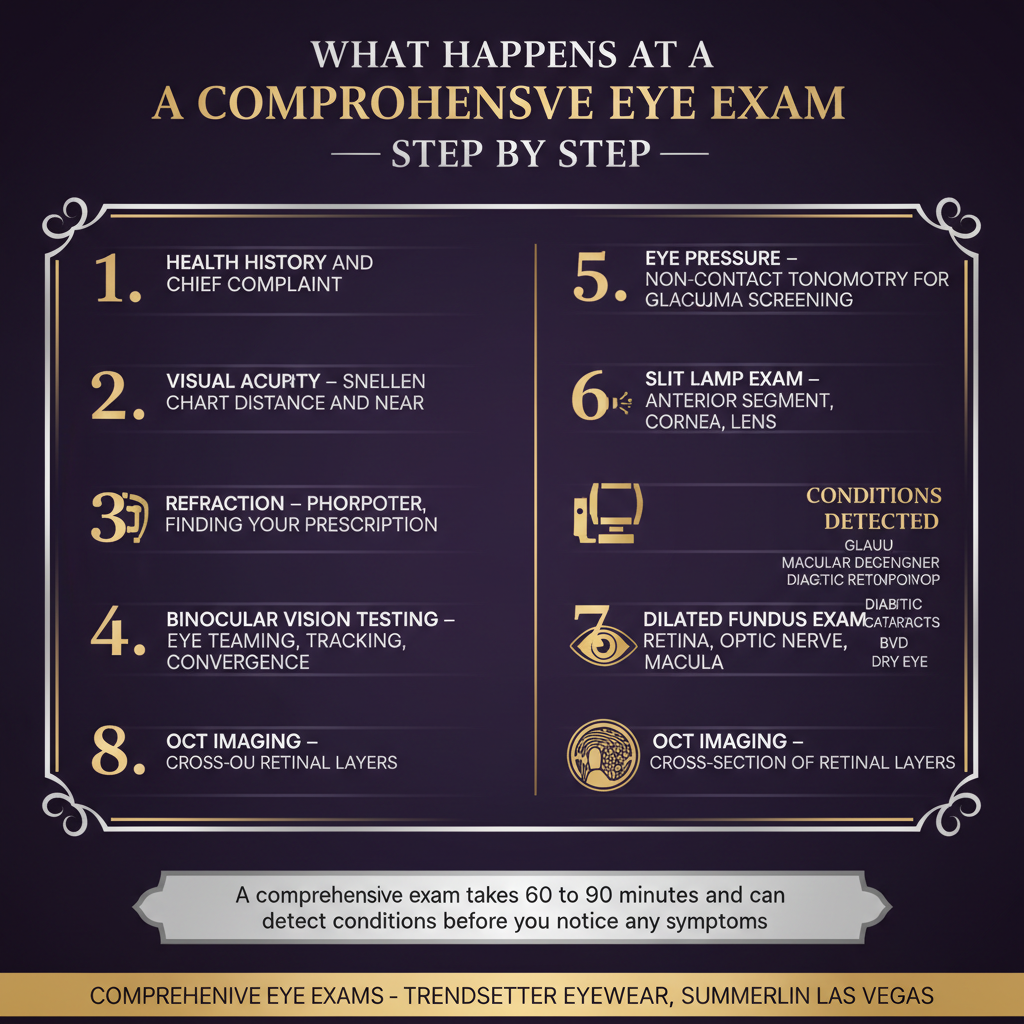
Each step builds on the last — from basic acuity to deep retinal imaging. The full picture takes about 60–90 minutes and can reveal conditions you'd have no other way of knowing about.
1. Health and Vision History
Your exam begins with a conversation. Dr. Payne will ask about your current vision concerns, your medical history, family history of eye disease, and any symptoms you've been experiencing — including headaches, dizziness, or difficulty reading, which may point to conditions beyond simple refractive error.
This history is not a formality. It shapes the entire exam that follows.
2. Preliminary Testing
Before the refraction (the "which is better, one or two?" part), a series of preliminary tests establishes baseline measurements:
Visual acuity: How clearly you see at distance and near with your current correction.
Color vision: Screening for color deficiency, which can affect career choices and is important to identify early.
Depth perception: How well your two eyes work together to perceive three-dimensional space.
Pupil response: How your pupils react to light — abnormal responses can indicate neurological issues.
Eye movement and alignment: How well your eyes track and work together. This is where subtle signs of Binocular Vision Dysfunction (BVD) may first appear.
Visual field screening: A quick check for peripheral vision loss, which can indicate glaucoma or neurological conditions.
3. Refraction: Finding Your Prescription
This is the part most people recognize — the phoropter (the large instrument with multiple lenses) and the "which is clearer, one or two?" questions.
Refraction determines your refractive error: nearsightedness, farsightedness, and astigmatism. It also determines whether you need reading glasses or progressive lenses.
At Trendsetter Eyewear, we use both automated refraction technology and manual refinement to ensure the most accurate prescription possible. An automated reading alone isn't sufficient — the final prescription requires clinical judgment and patient feedback.
4. Binocular Vision Assessment
This is a component that many standard eye exams skip or minimize — and it's one we take seriously.
Binocular vision testing evaluates how well your two eyes work together as a team. This includes:
- Phoria testing: Measuring the tendency of the eyes to drift when the fusion mechanism is relaxed
- Vergence testing: How well your eyes can converge (turn in) and diverge (turn out)
- Accommodative testing: How well your eyes can shift focus between distances
Subtle binocular vision problems — particularly Binocular Vision Dysfunction (BVD) — can cause headaches, dizziness, reading difficulties, and anxiety that are routinely attributed to other causes. Identifying them requires specific testing that goes beyond standard refraction.
5. Tonometry: Measuring Eye Pressure
Elevated intraocular pressure is a primary risk factor for glaucoma, a leading cause of irreversible vision loss. Tonometry measures the pressure inside your eye.
At Trendsetter Eyewear, we use the iCare tonometer — a no-puff, no-air-blast device that measures pressure with a tiny probe that barely touches the eye surface. Most patients don't even feel it. This is a significant improvement over the traditional air-puff tonometer that many patients dread.
6. Slit Lamp Examination
The slit lamp is a microscope that allows Dr. Payne to examine the structures of your eye in detail:
- Eyelids and lashes: Signs of blepharitis, Demodex infestation, or meibomian gland dysfunction
- Conjunctiva and sclera: Redness, inflammation, or abnormal growths
- Cornea: Scratches, scars, dystrophies, or early keratoconus
- Anterior chamber: Depth and clarity of the fluid-filled space in front of the lens
- Iris: Structural abnormalities
- Lens: Early cataract formation
The slit lamp examination is where many systemic conditions first show up in the eye — including diabetes, hypertension, and autoimmune diseases.
7. Dilated Fundus Examination
Dilation involves placing drops in your eyes that temporarily widen your pupils, allowing Dr. Payne to examine the back of the eye (the fundus) in detail.
This examination evaluates:
- Optic nerve: Size, shape, and color — changes can indicate glaucoma or neurological conditions
- Macula: The central area of the retina responsible for sharp central vision; early macular degeneration appears here
- Retinal blood vessels: Narrowing, crossing changes, or hemorrhages can indicate hypertension or diabetes
- Peripheral retina: Tears, holes, or detachments that could threaten vision
- Vitreous: The gel-like substance filling the eye; floaters and flashes originate here
Dilation causes temporary light sensitivity and blurry near vision for 2–4 hours. We recommend bringing sunglasses and, if possible, having someone drive you home.
8. Advanced Diagnostic Imaging (When Indicated)
Depending on your history and findings, Dr. Payne may recommend additional testing:
Optical Coherence Tomography (OCT): Creates detailed cross-sectional images of the retina and optic nerve, detecting changes too subtle to see with the naked eye. Essential for monitoring glaucoma and macular degeneration.
Corneal topography: Maps the curvature of the cornea — important for contact lens fitting, LASIK candidacy evaluation, and detecting keratoconus.
Meibography: Imaging of the meibomian glands to assess their structure and function — a key component of dry eye evaluation.
What Conditions Can an Eye Exam Detect?
Beyond vision problems, a comprehensive eye exam can detect or provide early warning of:
- Glaucoma (often has no symptoms until significant vision loss has occurred)
- Diabetic retinopathy (often the first sign of uncontrolled diabetes)
- Hypertensive retinopathy (changes in retinal blood vessels from high blood pressure)
- Macular degeneration
- Cataracts
- Retinal tears and detachments
- Multiple sclerosis (optic nerve changes)
- Brain tumors (visual field defects)
- Thyroid disease
- Autoimmune conditions
This is why annual eye exams matter even if you see perfectly well. Many serious conditions are asymptomatic in their early stages.
How Often Should You Have a Comprehensive Eye Exam?
Adults under 40 with no risk factors: Every 1–2 years
Adults 40 and over: Annually — the risk of age-related eye conditions increases significantly after 40
Patients with diabetes, hypertension, or family history of glaucoma: Annually or as recommended
Children: First exam by age 3, then annually once school-age — vision problems can significantly affect learning
Contact lens wearers: Annually — contact lens prescriptions require a separate fitting evaluation
Schedule Your Comprehensive Eye Exam
If it's been more than a year since your last exam — or if you've never had a truly comprehensive evaluation — we'd love to see you.
Dr. Payne takes the time to do this right. Our exams typically run 60–90 minutes because we don't rush through the components that matter.
Book your appointment online or call us at (702) 479-5222. We're located in Summerlin at 1225 S Fort Apache Rd #145.
Explore Topics
Written by
Dr. Cynthia Payne, OD
Content creator and writer sharing insights and stories.


