
Macular Degeneration: Prevention, Early Detection, and Living Well With AMD
Age-related macular degeneration is the leading cause of central vision loss in adults over 50. Here is what you need to know about risk factors, early detection, and the lifestyle changes that can slow its progression.

Macular Degeneration: Prevention, Early Detection, and Living Well With AMD
Age-related macular degeneration (AMD) is the leading cause of central vision loss in adults over 50 in the developed world. It affects the macula — the small, central portion of the retina responsible for the sharp, detailed vision you use for reading, recognizing faces, and driving. Understanding AMD, its risk factors, and the steps you can take to protect your central vision is one of the most important things you can do for your long-term eye health.
What Is the Macula?
The macula is a small area at the center of the retina, roughly 5mm in diameter, that contains the highest concentration of photoreceptors (cones) in the eye. It is responsible for your central visual acuity — the sharp, detailed vision that allows you to read fine print, see faces clearly, and perform tasks that require precise vision.
When the macula is damaged by AMD, central vision becomes blurred, distorted, or lost — while peripheral vision typically remains intact. This is why AMD patients often describe a blurry or dark spot in the center of their vision.
Types of AMD
Dry AMD (Atrophic)
Dry AMD accounts for approximately 85–90% of all AMD cases. It involves the gradual accumulation of small deposits called drusen beneath the retina, along with progressive thinning and atrophy of the retinal pigment epithelium (RPE) — the layer of cells that supports the photoreceptors.
Dry AMD progresses slowly over years and may cause gradual central vision loss. In its advanced form — geographic atrophy — large areas of the RPE and photoreceptors are lost, causing significant central vision impairment.
Wet AMD (Neovascular)
Wet AMD accounts for only 10–15% of cases but is responsible for approximately 90% of severe vision loss from AMD. It involves the growth of abnormal blood vessels beneath the retina (choroidal neovascularization). These vessels are fragile and leak fluid and blood, causing rapid and severe central vision distortion and loss.
Wet AMD can develop from dry AMD and requires prompt treatment to prevent permanent vision loss.
Risk Factors
- Age — The most significant risk factor; prevalence increases dramatically after age 60
- Smoking — The most significant modifiable risk factor; smokers have 2–4 times the risk of non-smokers
- Family history — AMD has a strong genetic component
- Cardiovascular disease — Hypertension, high cholesterol, and atherosclerosis are associated with AMD
- UV exposure — Cumulative sun exposure, particularly in high-UV environments like Las Vegas
- Obesity — Associated with increased AMD progression
- Light iris color — Blue or green eyes may be at slightly higher risk
- Diet — Low intake of antioxidants and omega-3 fatty acids is associated with higher risk
Early Detection: Why It Matters
In its early stages, AMD causes no symptoms. Drusen deposits and early RPE changes are only detectable on examination — which is why regular comprehensive eye exams with OCT imaging are essential for adults over 50.
Early detection matters because:
- Dry AMD can be slowed with AREDS2 supplementation (a specific formulation of antioxidants and zinc) when started in the intermediate stage
- Wet AMD can be treated effectively with anti-VEGF injections when caught early — preserving and sometimes improving vision
- Lifestyle modifications are most effective when implemented before significant damage has occurred
The Amsler Grid: Self-Monitoring at Home
Patients with known AMD or high risk factors can monitor their central vision at home using an Amsler grid — a simple grid of horizontal and vertical lines with a central dot. When viewed with one eye at a time, distortion, waviness, or missing areas in the grid lines can indicate progression of AMD or the development of wet AMD.
Any new distortion or change in your Amsler grid should prompt an urgent call to your eye doctor — wet AMD can progress rapidly and requires prompt treatment.
Prevention and Lifestyle
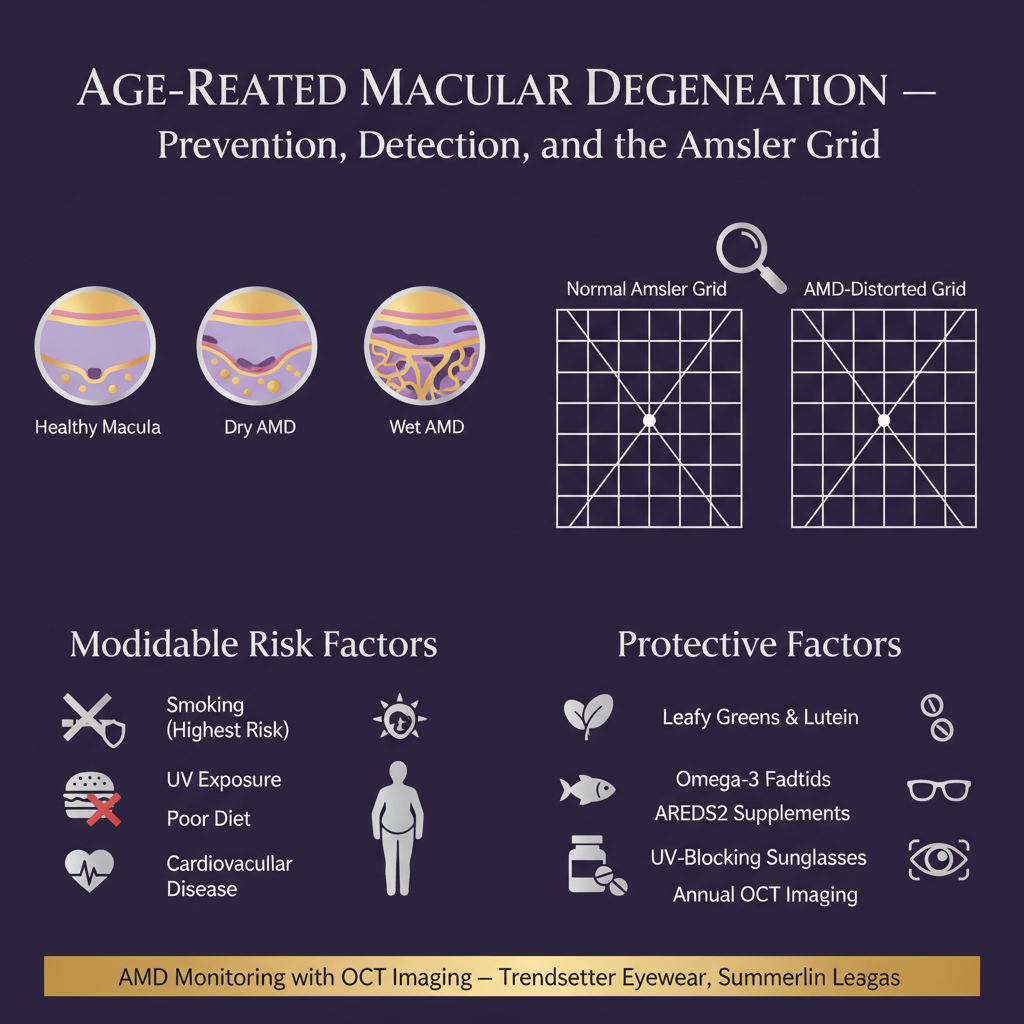
AMD has no cure — but its progression is highly modifiable. The lifestyle factors that protect your cardiovascular system protect your macula too, and early detection with OCT imaging can preserve years of central vision.
While AMD cannot be completely prevented, several evidence-based strategies can reduce risk and slow progression:
- Stop smoking — The single most impactful modifiable risk factor
- AREDS2 supplements — For patients with intermediate AMD; the specific formulation (lutein/zeaxanthin, vitamin C, vitamin E, zinc, copper) has been shown to reduce progression risk by 25%
- Eat a Mediterranean-style diet — Rich in leafy greens, colorful vegetables, fatty fish, and olive oil
- Wear UV-protective sunglasses — Particularly important in Las Vegas's high-UV environment
- Control cardiovascular risk factors — Blood pressure, cholesterol, and blood sugar management
- Exercise regularly — Associated with reduced AMD risk and progression
AMD Care at Trendsetter Eyewear
At Trendsetter Eyewear, Dr. Cynthia Payne uses advanced OCT imaging to detect AMD at its earliest stage and monitor progression with precision. For patients with known AMD, we provide detailed monitoring, AREDS2 supplementation guidance, and coordination with retinal specialists when treatment is needed.
Call (702) 479-5222 or schedule your comprehensive eye exam at our Summerlin, Las Vegas location. Protecting your central vision starts with knowing what is happening before you notice any change.
Explore Topics
Written by
Dr. Cynthia Payne, OD
Content creator and writer sharing insights and stories.


