
Sun Damage and Your Eyes: What Living in Las Vegas Does Over Time
Las Vegas receives more UV radiation than almost any other major US city. Here is what cumulative sun exposure does to your eyes over decades — and the simple habits that protect your vision for life.

Sun Damage and Your Eyes: What Living in Las Vegas Does Over Time
Las Vegas receives approximately 294 sunny days per year and sits at an elevation of 2,001 feet — high enough that UV radiation is measurably more intense than at sea level. The combination of year-round sun, high altitude, and the reflective surfaces of the desert environment (sand, pavement, glass buildings) creates a UV exposure burden that is among the highest of any major US city.
Most people understand that sun exposure damages skin. Fewer understand that it damages eyes — and that the damage accumulates silently over decades before manifesting as vision-threatening conditions.
How UV Radiation Damages the Eye
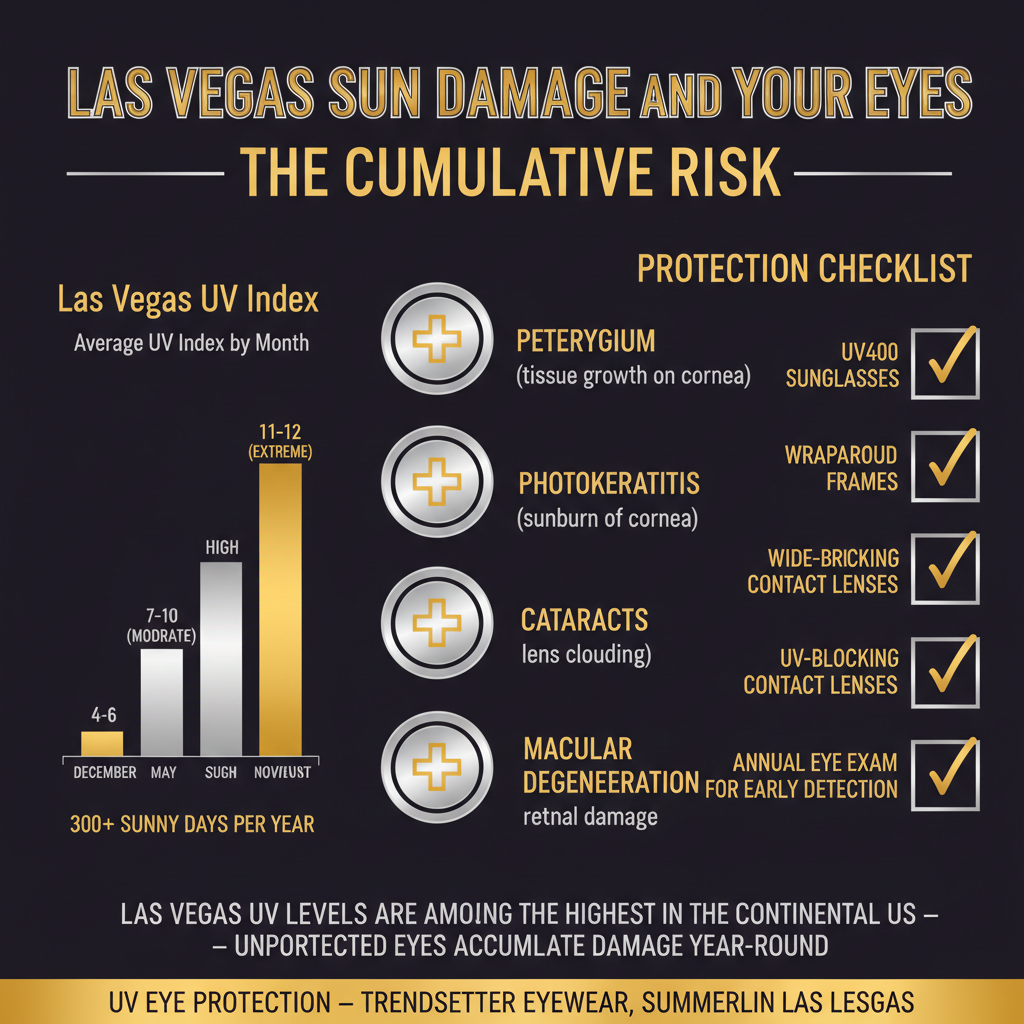
Las Vegas UV levels are among the highest in the continental US — unprotected eyes accumulate damage year-round, not just in summer. The combination of high altitude, desert reflectivity, and 300+ sunny days makes UV protection here more urgent than in most US cities.
Ultraviolet radiation affects virtually every structure of the eye:
The Cornea
Acute UV overexposure causes photokeratitis — essentially a corneal sunburn. Symptoms include intense pain, light sensitivity, tearing, and temporary vision loss, typically appearing 6–12 hours after exposure. Photokeratitis heals within 24–48 hours but repeated episodes cause cumulative damage to the corneal epithelium.
The Lens
The crystalline lens absorbs UV radiation to protect the retina — but at the cost of oxidative damage to lens proteins. This oxidative damage accumulates over decades and is a primary driver of cataract formation. Studies consistently show that people with higher lifetime UV exposure develop cataracts earlier and more severely than those who protect their eyes.
In Las Vegas, where UV exposure is intense and year-round, the cataract risk is meaningfully higher than in less sunny climates.
The Macula
The macula — the central portion of the retina responsible for sharp, detailed vision — is particularly vulnerable to oxidative damage from UV and high-energy visible (HEV) light. Cumulative light exposure is a significant risk factor for age-related macular degeneration, the leading cause of central vision loss in adults over 50.
The Conjunctiva and Sclera
UV exposure causes pinguecula — yellowish deposits on the conjunctiva — and pterygium — a fleshy growth that can extend onto the cornea. Both conditions are significantly more common in high-UV environments. Pterygium can cause chronic irritation, redness, and in advanced cases, vision distortion as it encroaches on the cornea.
The Eyelid Skin
The eyelid skin is among the thinnest and most UV-sensitive skin on the body. Basal cell carcinoma of the eyelid accounts for approximately 90% of eyelid malignancies and is strongly associated with cumulative UV exposure. The lower eyelid is most commonly affected, as it receives more direct UV exposure.
The Cumulative Nature of UV Damage
This is the critical point: UV damage to the eye is cumulative and largely irreversible. The cataracts, macular changes, and conjunctival damage that develop in your 60s and 70s are the result of UV exposure accumulated over your entire lifetime — including childhood and young adulthood.
This means that the protective habits you establish now — regardless of your age — will meaningfully affect your eye health decades from now. And for parents, protecting children's eyes from UV is particularly important: children spend more time outdoors, their lenses transmit more UV to the retina (the lens becomes more UV-absorbing with age), and the cumulative damage clock starts early.
Protecting Your Eyes in Las Vegas
Wear UV-Protective Sunglasses — Every Day
This is the single most important protective measure. Look for sunglasses labeled "100% UV protection" or "UV400" — meaning they block all UV radiation up to 400nm. Lens darkness does not indicate UV protection; a dark lens without UV coating can actually increase UV exposure by causing pupil dilation.
Larger frames with wraparound coverage provide better protection than small fashion frames. Polarized lenses add glare reduction but do not provide additional UV protection beyond UV400 lenses.
Wear a Brimmed Hat
A wide-brimmed hat (3+ inches) reduces UV exposure to the eyes and periocular skin by approximately 50%. Combined with sunglasses, it provides comprehensive protection.
Protect Children's Eyes
Children's lenses transmit significantly more UV to the retina than adult lenses. UV-protective sunglasses for children are not optional — they are a meaningful investment in long-term eye health.
Get Regular Eye Exams
Annual comprehensive eye exams allow early detection of UV-related changes — pinguecula, pterygium, early cataract, and macular changes — when intervention is most effective.
UV Protection at Trendsetter Eyewear
At Trendsetter Eyewear, our sunglass collection — including luxury brands like Tom Ford, Dior, Gucci, and Cartier — provides 100% UV protection combined with the craftsmanship and aesthetic quality our patients expect. We also offer prescription sunglass services and can discuss the best UV protection options for your specific needs and lifestyle.
Call (702) 479-5222 or visit us in Summerlin to find the right UV protection for Las Vegas living. Your eyes will thank you in 20 years.
Explore Topics
Written by
Dr. Cynthia Payne, OD
Content creator and writer sharing insights and stories.


