
Swimming Pools and Eye Health: What Las Vegas Swimmers Need to Know
Las Vegas has one of the highest per-capita pool densities in the country. Here is what pool water does to your eyes, how to protect them, and what to do if you develop symptoms after swimming.

Swimming Pools and Eye Health: What Las Vegas Swimmers Need to Know
Las Vegas has one of the highest per-capita swimming pool densities in the United States — and with summer temperatures regularly exceeding 110°F, pool use is a year-round activity for many residents. But pool water — whether chlorinated, saltwater, or otherwise treated — has real effects on your eyes that are worth understanding.
What Pool Water Does to Your Eyes
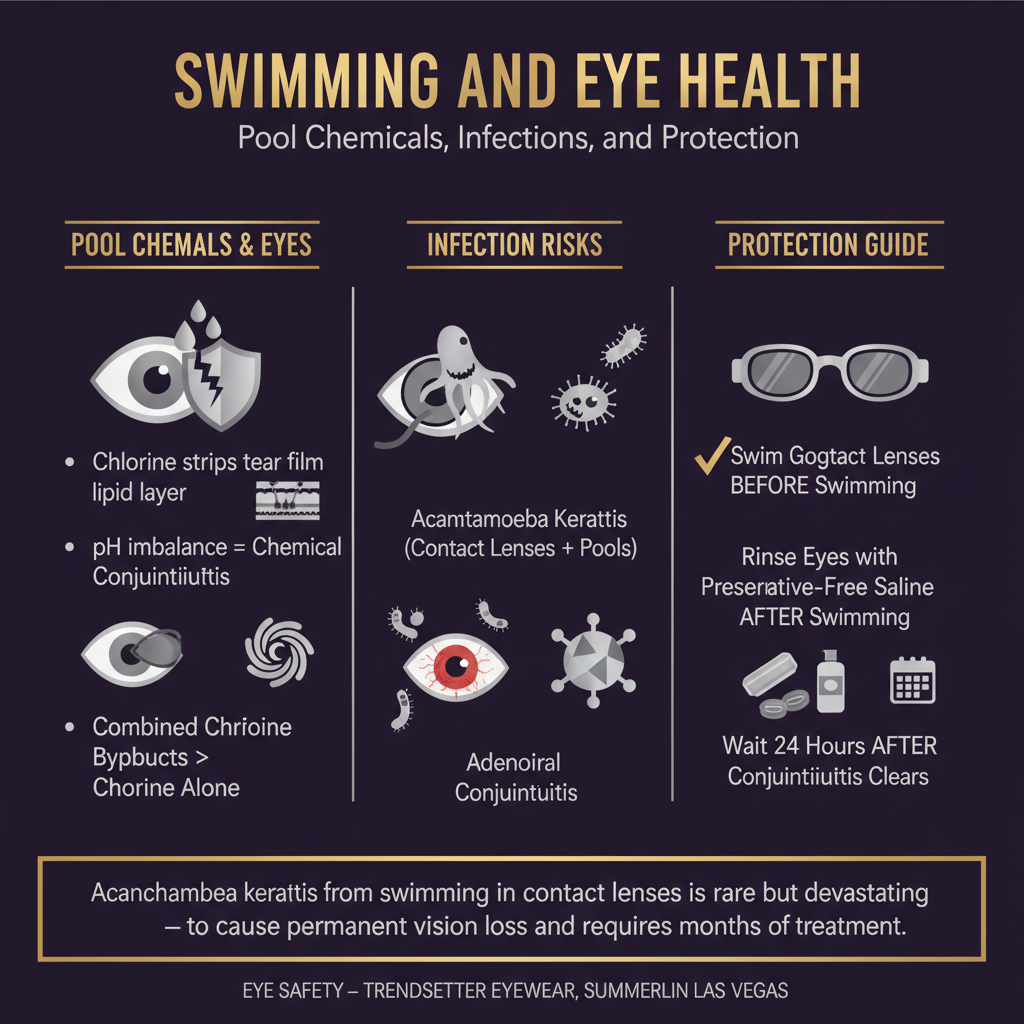
Acanthamoeba keratitis from swimming in contact lenses is rare but devastating — it can cause permanent vision loss and requires months of treatment. In Las Vegas, where outdoor pools are used year-round, this risk is present every season, not just summer.
The Chlorine Myth
Many people assume that the eye irritation they experience in pools is caused by chlorine. In reality, the irritant is not chlorine itself — it is chloramines: compounds formed when chlorine reacts with organic material in the water, including sweat, urine, body oils, and cosmetics.
Chloramines are what cause the characteristic "pool smell" and the red, irritated eyes that swimmers experience. A well-maintained pool with appropriate chlorine levels and low organic load actually produces fewer chloramines and less eye irritation than a poorly maintained pool.
Disruption of the Tear Film
Pool water — regardless of treatment method — is hypotonic (lower salt concentration than tears) and disrupts the tear film. The surfactants and chemicals in pool water wash away the lipid layer of the tear film, leading to increased evaporation and dry eye symptoms after swimming.
For patients who already have dry eye, swimming can significantly worsen symptoms — particularly in Las Vegas, where the dry air accelerates tear evaporation after exiting the pool.
Microbial Exposure
Pool water contains microorganisms that can cause eye infections. The most common pool-related eye infection is Acanthamoeba keratitis — a serious corneal infection caused by a microscopic organism found in water. While relatively rare, Acanthamoeba keratitis is particularly associated with contact lens wear in water and can cause severe, vision-threatening corneal damage.
Never swim with contact lenses in. This is one of the most important eye health rules for swimmers.
UV Exposure
Pool environments — particularly outdoor pools — involve significant UV exposure from both direct sunlight and reflection off the water surface. Water reflects approximately 10% of UV radiation, increasing total UV exposure during outdoor swimming.
Protecting Your Eyes While Swimming
Wear Swim Goggles
Swim goggles are the most effective protection against pool water exposure. They create a sealed barrier that prevents pool water from contacting the ocular surface entirely. For regular swimmers — particularly those with dry eye, contact lens wearers, or those with corneal conditions — goggles are strongly recommended.
Prescription swim goggles are available for patients who need vision correction while swimming.
Remove Contact Lenses Before Swimming
This cannot be overstated. Contact lenses trap microorganisms against the corneal surface and dramatically increase the risk of serious eye infections, including Acanthamoeba keratitis. Remove lenses before entering any body of water — pool, ocean, lake, or hot tub.
Rinse Your Eyes After Swimming
Rinsing with clean water or preservative-free saline after swimming helps remove residual pool chemicals from the ocular surface. Preservative-free artificial tears after swimming can help restore the tear film.
Wear UV-Protective Sunglasses Poolside
When not in the water, UV-protective sunglasses protect against the combined UV exposure from direct sunlight and water reflection.
Symptoms That Warrant a Visit to the Eye Doctor
Most post-swimming eye irritation resolves within a few hours with rinsing and artificial tears. However, see an eye doctor if you experience:
- Persistent redness lasting more than 24 hours after swimming
- Pain or significant light sensitivity — These suggest a more serious condition
- Blurred vision that does not clear
- Discharge — Particularly if thick or colored (suggests bacterial infection)
- A white spot on the cornea — This is a medical emergency; seek care immediately
Swimmer's Eye: Chronic Exposure Effects
Regular swimmers who do not use goggles often develop chronic changes to the ocular surface over time:
- Chronic dry eye from repeated tear film disruption
- Conjunctival changes — Thickening and redness of the conjunctiva
- Pterygium — A fleshy growth on the white of the eye, associated with UV and chemical exposure
- Corneal staining — Visible on examination with fluorescein dye, indicating chronic surface damage
If you are a regular swimmer experiencing persistent eye symptoms, a comprehensive eye exam at Trendsetter Eyewear can assess the health of your ocular surface and recommend appropriate management.
Call (702) 479-5222 or schedule an appointment at our Summerlin, Las Vegas location.
Explore Topics
Written by
Dr. Cynthia Payne, OD
Content creator and writer sharing insights and stories.


