
Lens Coatings Explained: Anti-Reflective, UV, Scratch-Resistant, and More
The right lens coatings can dramatically improve the performance, durability, and appearance of your eyeglasses. Here is a clear guide to the most important coatings and which ones are worth the investment.

Lens Coatings Explained: Anti-Reflective, UV, Scratch-Resistant, and More
When you invest in quality eyeglass lenses, the coatings applied to those lenses can make a significant difference in how well they perform, how long they last, and how they look. But the world of lens coatings can be confusing — there are many options, varying quality levels, and marketing claims that are not always straightforward.
Here is a clear, practical guide to the most important lens coatings and which ones are genuinely worth the investment.
Anti-Reflective (AR) Coating
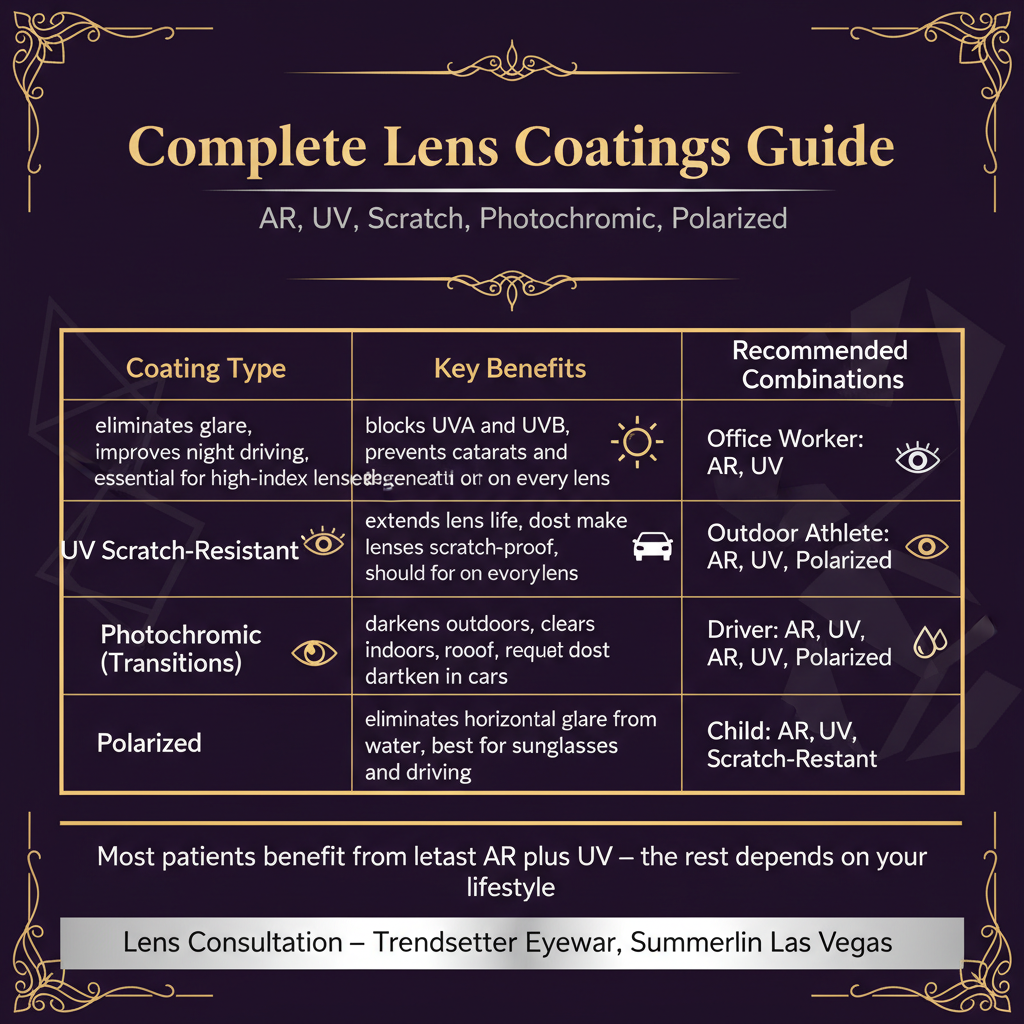
Most patients benefit from at least AR plus UV — the rest depends on your lifestyle. The combinations that matter most are AR for anyone who drives or uses screens, and photochromic or polarized for anyone who spends significant time outdoors in Las Vegas.
Anti-reflective coating is, in my opinion, the single most important coating for most patients. It is not optional — it is essential.
What It Does
AR coating reduces the reflections on the front and back surfaces of the lens. Without AR coating, approximately 8% of light is reflected off each lens surface rather than passing through to your eye. This reflected light creates:
- Glare from oncoming headlights while driving at night
- Reflections visible to others when they look at you (making eye contact difficult)
- Reduced contrast and visual clarity, particularly in low-light conditions
- Increased eye strain during screen use
What to Look For
Not all AR coatings are equal. Premium AR coatings include:
- Hydrophobic layer — Repels water and prevents water spots
- Oleophobic layer — Repels oils and fingerprints, making the lens easier to clean
- Anti-static layer — Reduces dust attraction
- Scratch-resistant hard coat — Integrated into the coating stack
Budget AR coatings often lack these additional layers and may peel, crack, or develop a greenish hue over time. At Trendsetter Eyewear, we use only premium AR coating systems on our lenses.
Who Needs It
Everyone. AR coating is particularly important for:
- Night drivers
- Screen users
- Patients with high prescriptions (thicker lenses reflect more light)
- Anyone who values clear, natural-looking lenses
UV Protection
Ultraviolet radiation is a significant risk factor for cataracts, macular degeneration, and pterygium (a growth on the white of the eye). In Las Vegas — one of the sunniest cities in the United States — UV protection is not optional.
What to Know
Most modern plastic (polycarbonate, Trivex, and high-index) lenses have UV protection built into the lens material itself — not as a surface coating. This means UV protection is present even without a separate UV coating.
Glass lenses do not inherently block UV and require a UV coating.
Important: UV protection in clear lenses does not protect the skin around the eyes from UV exposure. For complete protection, wear sunglasses with UV-blocking lenses and frames that provide peripheral coverage.
Scratch-Resistant Coating
All optical lenses — even glass — can scratch. Scratch-resistant coating (also called hard coat) is a thin, hard layer applied to the lens surface that significantly reduces scratching from everyday handling.
What to Know
- Scratch-resistant coating does not make lenses scratch-proof — it makes them scratch-resistant
- Premium AR coatings typically include a scratch-resistant layer as part of the coating stack
- Polycarbonate and Trivex lenses are inherently more impact-resistant than standard plastic but are also more prone to surface scratching — making scratch-resistant coating particularly important for these materials
Photochromic Lenses (Transitions)
Photochromic lenses darken automatically in UV light and return to clear indoors. They are a convenient option for patients who want one pair of glasses that works both indoors and outdoors.
What to Know
- Modern photochromic lenses (Transitions Gen 8, XTRActive) activate faster and clear faster than older generations
- They do not darken significantly inside cars (windshields block the UV that triggers the darkening reaction) — XTRActive is designed to address this
- They are not a substitute for dedicated sunglasses for activities like driving or extended outdoor time
- Available in a range of colors beyond the traditional gray and brown, including green and violet
Polarized Lenses
Polarized lenses reduce glare from horizontal reflective surfaces — water, roads, snow, glass. They are particularly valuable for:
- Driving (reduces road glare)
- Water activities (fishing, boating, beach)
- Snow sports
- Any outdoor activity in bright conditions
Polarized lenses are available in prescription and non-prescription versions and can be combined with photochromic technology.
Mirror Coatings
Mirror coatings are applied to the front surface of sunglass lenses, reflecting light away from the eye. They reduce the amount of light entering the eye and provide a distinctive aesthetic. Mirror coatings are available in a range of colors and finishes — silver, gold, blue, rose, and more.
Choosing the Right Coatings
For most patients, the essential coating package is:
- Premium AR coating (with hydrophobic, oleophobic, and scratch-resistant layers) — Always
- UV protection — Built into most modern lens materials
- Photochromic or polarized — If you want convenience or outdoor performance
At Trendsetter Eyewear, we discuss coating options with every patient and recommend the combination that best suits your prescription, lifestyle, and frame choice.
Call (702) 479-5222 or schedule an appointment at our Summerlin, Las Vegas location.
Explore Topics
Written by
Dr. Cynthia Payne, OD
Content creator and writer sharing insights and stories.


