
Progressive Lenses: A Complete Guide to No-Line Multifocals
Progressive lenses correct vision at all distances without the visible line of bifocals — but they take some adjustment. Here is everything you need to know about choosing, fitting, and adapting to progressive lenses.

Progressive Lenses: A Complete Guide to No-Line Multifocals
If you are over 40 and finding that your arms are not quite long enough to read the menu, you are experiencing presbyopia — the gradual loss of near focusing ability that affects virtually everyone as the crystalline lens of the eye stiffens with age. Progressive lenses are the most popular solution, offering clear vision at all distances — distance, intermediate (computer), and near — in a single, seamless lens without the visible line of traditional bifocals.
But progressive lenses are not all created equal, and the fitting process matters enormously. Here is everything you need to know.
How Progressive Lenses Work
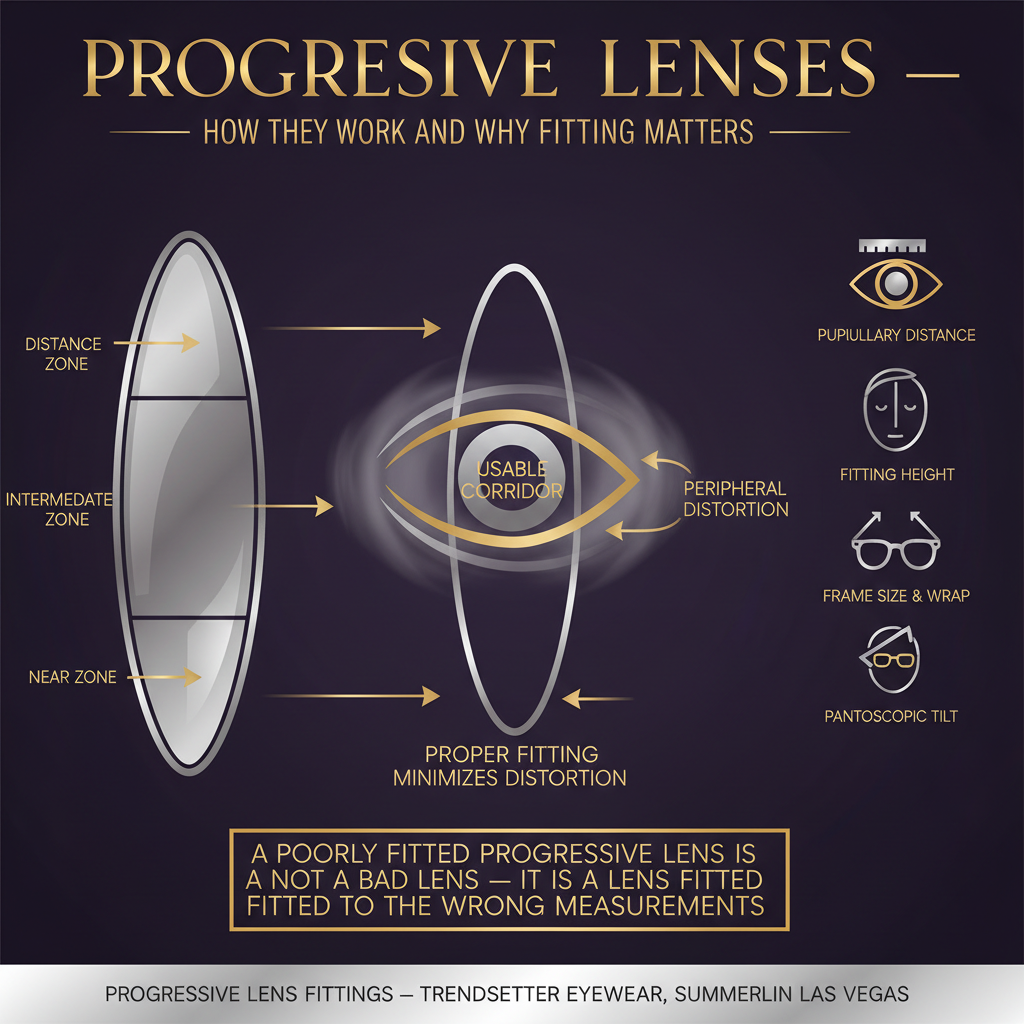
A poorly fitted progressive lens is not a bad lens — it is a lens fitted to the wrong measurements. The corridor width, distortion zones, and usable reading area are all determined by how precisely the lens is positioned in the frame relative to your pupil.
A progressive lens contains a continuous gradient of lens power from top to bottom:
- Upper portion — Distance prescription (for driving, watching TV, seeing across a room)
- Middle corridor — Intermediate prescription (for computer use, dashboard, shelves)
- Lower portion — Near prescription (for reading, phone, close work)
The transition between these zones is seamless — no visible line. The wearer learns to position their gaze in the appropriate zone for each task: looking straight ahead for distance, slightly down for intermediate, and further down for near.
The Peripheral Distortion Issue
Progressive lenses have an inherent optical limitation: the power gradient creates areas of distortion in the peripheral portions of the lens, particularly in the lower corners. This is why new progressive wearers sometimes experience a "swim" effect when moving their head, or notice that straight lines appear slightly curved.
The width of the clear corridor — and the extent of the peripheral distortion — varies significantly between different progressive lens designs. This is one of the most important factors in choosing the right progressive lens.
Progressive Lens Designs: Not All Are Equal
Standard (Conventional) Progressives
Standard progressive designs have a relatively narrow corridor and more pronounced peripheral distortion. They are less expensive but require more adaptation time and may never feel fully comfortable for some wearers.
Premium Digital Progressives
Premium progressive lenses are manufactured using digital (free-form) surfacing technology, which allows the lens to be customized to the wearer's specific prescription, frame measurements, and wearing position. The result is a wider clear corridor, less peripheral distortion, and faster adaptation.
At Trendsetter Eyewear, we recommend premium digital progressives for most patients — the difference in comfort and visual quality is significant, and the adaptation period is typically much shorter.
Occupational Progressives
Occupational progressive lenses are designed for specific visual tasks — typically computer use. They provide a wider intermediate zone and a wider near zone, at the expense of distance vision. They are ideal as a second pair for patients who spend long hours at a computer.
The Fitting Process: Why It Matters
Progressive lenses are more sensitive to fitting accuracy than single-vision lenses. The optical centers must be precisely aligned with the wearer's pupils, and the frame must sit at the correct height and angle on the face. A poorly fitted progressive lens — even a premium design — will be uncomfortable and difficult to adapt to.
At Trendsetter Eyewear, our fitting process for progressive lenses includes:
- Precise pupillary distance measurement — Both monocular PD (each eye measured separately) and near PD
- Fitting height measurement — The vertical position of the pupil within the frame, measured with the frame on the patient's face
- Pantoscopic tilt and wrap angle — The angle at which the frame sits on the face, which affects the optical performance of the lens
- Frame selection guidance — Not all frames work well with progressive lenses; we help you choose a frame with adequate vertical depth and appropriate geometry
Adapting to Progressive Lenses
Most patients adapt to premium progressive lenses within 1–2 weeks. During the adaptation period:
- Move your head, not just your eyes — Point your nose at what you want to see clearly
- Look through the appropriate zone — Straight ahead for distance, chin slightly down for intermediate, further down for near
- Wear them consistently — The more you wear them, the faster your brain adapts
- Avoid switching back and forth with old glasses during the adaptation period
If you are still experiencing significant distortion or discomfort after 2 weeks, come back in — the fitting measurements may need adjustment, or a different lens design may be more appropriate.
Progressive Lenses and Luxury Frames
One consideration when choosing luxury frames for progressive lenses: the frame must have adequate vertical depth (typically at least 28–30mm) to accommodate all three zones of the progressive lens. Very small or very shallow frames limit the usable area of the progressive, particularly the near zone.
At Trendsetter Eyewear, we can advise you on which frames in our luxury collection — including Cartier, Tom Ford, Dior, and others — are best suited for progressive lenses.
Call (702) 479-5222 or schedule an appointment at our Summerlin, Las Vegas location to discuss progressive lens options and find the right solution for your vision needs.
Explore Topics
Written by
Dr. Cynthia Payne, OD
Content creator and writer sharing insights and stories.


