
Blue Light Lenses: Do They Actually Work? What the Research Says
Blue light blocking lenses are one of the most marketed optical products of the past decade — but the science behind them is more nuanced than the marketing suggests. Here is an honest look at what blue light lenses do and do not do.

Blue Light Lenses: Do They Actually Work? What the Research Says
Blue light blocking lenses have become one of the most popular optical products of the past decade, marketed as a solution for digital eye strain, sleep disruption, and even macular degeneration. But the science behind these claims is more nuanced — and in some cases more limited — than the marketing suggests.
As an eye care professional, I believe patients deserve an honest assessment of what blue light lenses can and cannot do, so they can make informed decisions about their eyewear.
What Is Blue Light?
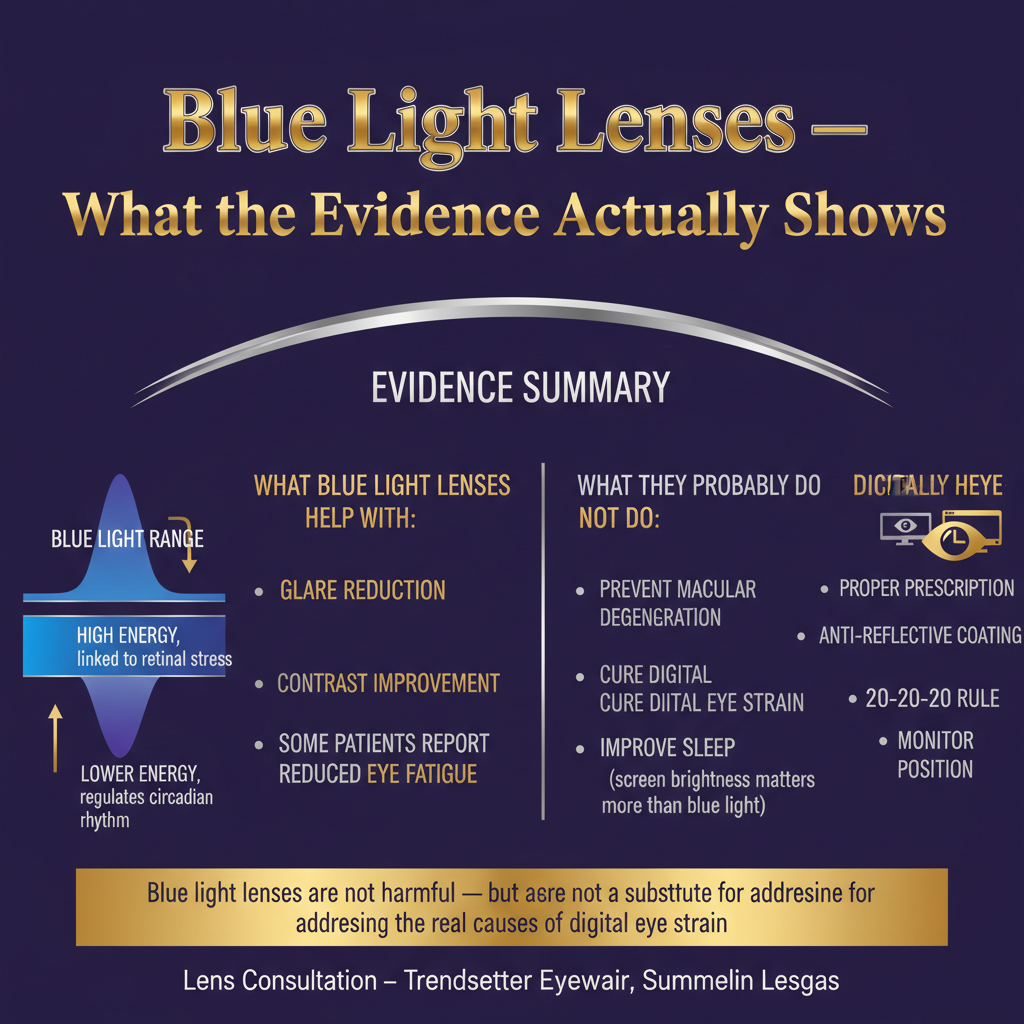
Blue light lenses are not harmful — but they are not a substitute for addressing the real causes of digital eye strain. The evidence supports modest glare and contrast benefits; the sleep and retinal protection claims are not well supported by current research.
Blue light is a portion of the visible light spectrum with wavelengths between approximately 380–500 nanometers. It is high-energy visible (HEV) light — the highest-energy portion of the visible spectrum, just below UV light.
Blue light is everywhere: sunlight is the largest source, by far. Digital screens (phones, computers, tablets) emit blue light, but at levels dramatically lower than sunlight. The blue light from a typical computer screen is roughly 1,000 times less intense than outdoor sunlight.
What Blue Light Lenses Actually Do
Blue light lenses use a coating or tint that filters out a portion of blue light — typically 20–40% of blue wavelengths, depending on the product. Some lenses have a slight yellow tint; others are designed to be optically clear.
The Evidence: What Blue Light Lenses Help With
Sleep Quality
This is where the evidence for blue light filtering is strongest. Blue light in the 460–480nm range suppresses melatonin production by signaling to the brain that it is daytime. Exposure to blue light from screens in the hours before bed can delay sleep onset and reduce sleep quality.
Blue light filtering glasses worn in the 2–3 hours before bed have shown modest but real benefits in sleep onset and sleep quality in several studies. If you use screens heavily in the evening and have difficulty falling asleep, blue light glasses may be worth trying.
Reducing Glare and Visual Fatigue
Some patients report that blue light lenses reduce glare and visual fatigue during extended screen use. This effect may be partly due to the anti-reflective coating that typically accompanies blue light lenses, rather than the blue light filtering itself.
The Evidence: What Blue Light Lenses Probably Do Not Do
Prevent Digital Eye Strain
The American Academy of Ophthalmology does not recommend blue light glasses for preventing digital eye strain. The primary cause of digital eye strain is not blue light — it is reduced blink rate during screen use (we blink 60–70% less when staring at screens) and sustained near focus that fatigues the ciliary muscles.
The most effective treatment for digital eye strain is the 20-20-20 rule: every 20 minutes, look at something 20 feet away for 20 seconds. This gives the focusing muscles a break and stimulates blinking.
Prevent Macular Degeneration
Some marketing claims suggest that blue light from screens damages the macula. The evidence for this is extremely weak. The levels of blue light emitted by screens are far below the threshold shown to cause retinal damage in laboratory studies. The American Academy of Ophthalmology has stated that there is no scientific evidence that blue light from digital devices causes or accelerates macular degeneration.
What Actually Helps Digital Eye Strain
If you are experiencing eye strain, headaches, or blurred vision from screen use, the most evidence-based interventions are:
- The 20-20-20 rule — Every 20 minutes, look 20 feet away for 20 seconds
- Proper screen distance — Monitor should be approximately arm's length away (20–28 inches)
- Screen positioning — Top of screen at or slightly below eye level
- Reduce glare — Anti-reflective coating on lenses, matte screen protectors, proper room lighting
- Artificial tears — For dry eye symptoms associated with reduced blink rate
- Correct prescription — An outdated or incorrect prescription is a major cause of screen-related eye strain
- NeuroLens — For patients whose screen-related symptoms are driven by binocular vision misalignment
Should You Get Blue Light Lenses?
If you use screens heavily in the evening and have sleep difficulties, blue light glasses are a reasonable, low-risk option to try. If your primary concern is daytime eye strain, the evidence suggests that other interventions — particularly the 20-20-20 rule and a current prescription — will provide more benefit.
At Trendsetter Eyewear, we offer blue light filtering as an add-on coating option and can discuss whether it makes sense for your specific situation.
Call (702) 479-5222 or schedule an appointment at our Summerlin, Las Vegas location. We will help you find the lens solution that actually addresses your symptoms.
Related reading:
- Browse our designer eyewear collection — premium lens coatings available on every frame
- Dry eye and screen time — the blink rate problem screens create
- Anti-reflective coating: is it worth it? — the coating that actually reduces digital eye strain
Explore Topics
Written by
Dr. Cynthia Payne, OD
Content creator and writer sharing insights and stories.


