
Sunglasses and UV Protection: What You Need to Know for Las Vegas Eyes
Las Vegas receives more UV radiation than almost any other major US city. Here is what to look for in sunglasses, why UV protection matters for long-term eye health, and how to choose frames that actually protect your eyes.

Sunglasses and UV Protection: What You Need to Know for Las Vegas Eyes
Las Vegas receives approximately 294 sunny days per year — making it one of the sunniest major cities in the United States. Combined with the high altitude of the Mojave Desert and the intense UV index that comes with it, Las Vegas residents face a UV exposure burden that is significantly higher than the national average.
For your eyes, this matters. Cumulative UV exposure is a significant risk factor for cataracts, macular degeneration, pterygium, and even eyelid skin cancers. The right sunglasses are not a fashion accessory — they are a medical necessity.
What UV Does to Your Eyes
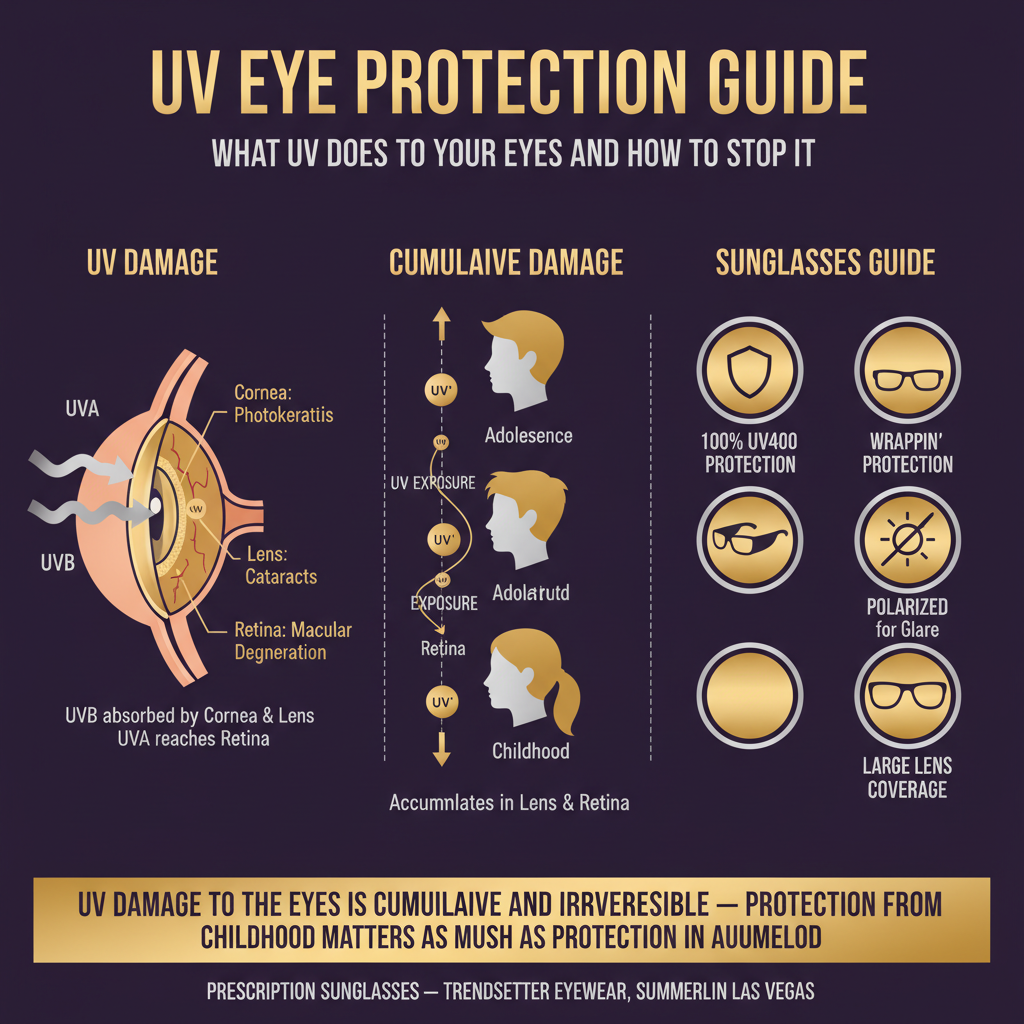
UV damage to the eyes is cumulative and irreversible — protection from childhood matters as much as protection in adulthood. A lifetime of unprotected UV exposure is the single largest modifiable risk factor for cataracts and macular degeneration.
Ultraviolet radiation damages the eye in several ways:
Cataracts
UV exposure — particularly UVB — accelerates the oxidative damage to lens proteins that causes cataracts. Studies show that people who spend significant time outdoors without UV-protective eyewear develop cataracts earlier than those who protect their eyes consistently.
Macular Degeneration
Cumulative UV and high-energy visible (HEV) light exposure is associated with increased risk of age-related macular degeneration. The macula is particularly vulnerable to oxidative damage from light exposure.
Pterygium
A pterygium is a fleshy growth on the white of the eye that can extend onto the cornea, causing irritation, redness, and in advanced cases, vision distortion. It is strongly associated with UV exposure and is significantly more common in sunny climates — including Las Vegas.
Photokeratitis
Photokeratitis is essentially a sunburn of the cornea — caused by intense UV exposure (snow, water, high altitude). It causes severe pain, light sensitivity, and temporary vision loss. It is the eye equivalent of a sunburn and heals within 24–48 hours, but repeated episodes cause cumulative damage.
Eyelid Skin Cancer
The eyelid skin is among the thinnest and most UV-sensitive skin on the body. Basal cell carcinoma and squamous cell carcinoma of the eyelid are not uncommon in high-UV environments. Sunglasses with larger frames and wraparound coverage protect the periocular skin as well as the eye itself.
What to Look for in Sunglasses
UV Protection: The Most Important Factor
Look for lenses labeled "100% UV protection" or "UV400" — meaning they block all UV radiation up to 400 nanometers (both UVA and UVB). This is non-negotiable.
Important: Lens darkness does not indicate UV protection. A dark lens without UV coating can actually be more harmful than no sunglasses at all — the dark lens causes the pupil to dilate, allowing more UV to enter the eye, without actually blocking the UV radiation.
Polarization
Polarized lenses reduce glare from horizontal reflective surfaces — roads, water, car hoods, buildings. In Las Vegas, where glare from pavement and glass is intense, polarization significantly improves visual comfort and reduces eye strain while driving.
Polarized lenses do not provide additional UV protection beyond standard UV400 lenses — but they dramatically improve visual comfort in bright conditions.
Lens Color
Different lens tints affect contrast and color perception:
- Gray — Neutral color perception; reduces brightness without distorting colors; ideal for general use and driving
- Brown/amber — Enhances contrast; good for variable light conditions and outdoor activities
- Green — Good color balance; reduces glare while maintaining natural color perception
- Yellow/amber — Enhances contrast in low-light and overcast conditions; not ideal for bright sun
- Mirrored — Reflects additional light; good for very bright conditions (snow, water, desert)
Frame Coverage
The frame should provide adequate coverage of the eye and periocular area. Wraparound styles offer the best protection by blocking UV from the sides as well as the front. For everyday wear, larger frames with close-fitting lenses provide better protection than small, fashion-forward styles.
Prescription Sunglasses
If you wear prescription glasses, prescription sunglasses are worth the investment. Clip-ons and fit-overs are functional but do not provide the same optical quality or comfort as purpose-made prescription sunglasses.
Alternatively, photochromic lenses (Transitions) provide UV protection and automatic darkening in sunlight — a convenient option for patients who do not want to manage two pairs of glasses.
Our Sunglass Collection
At Trendsetter Eyewear, our sunglass collection includes luxury brands — Tom Ford, Dior, Gucci, Prada, and others — that combine exceptional UV protection with the craftsmanship and aesthetic quality our patients expect. We also offer prescription sunglass services for all major brands.
Call (702) 479-5222 or visit us in Summerlin to explore our sunglass collection and find the right UV protection for Las Vegas living.
Explore Topics
Written by
Dr. Cynthia Payne, OD
Content creator and writer sharing insights and stories.


